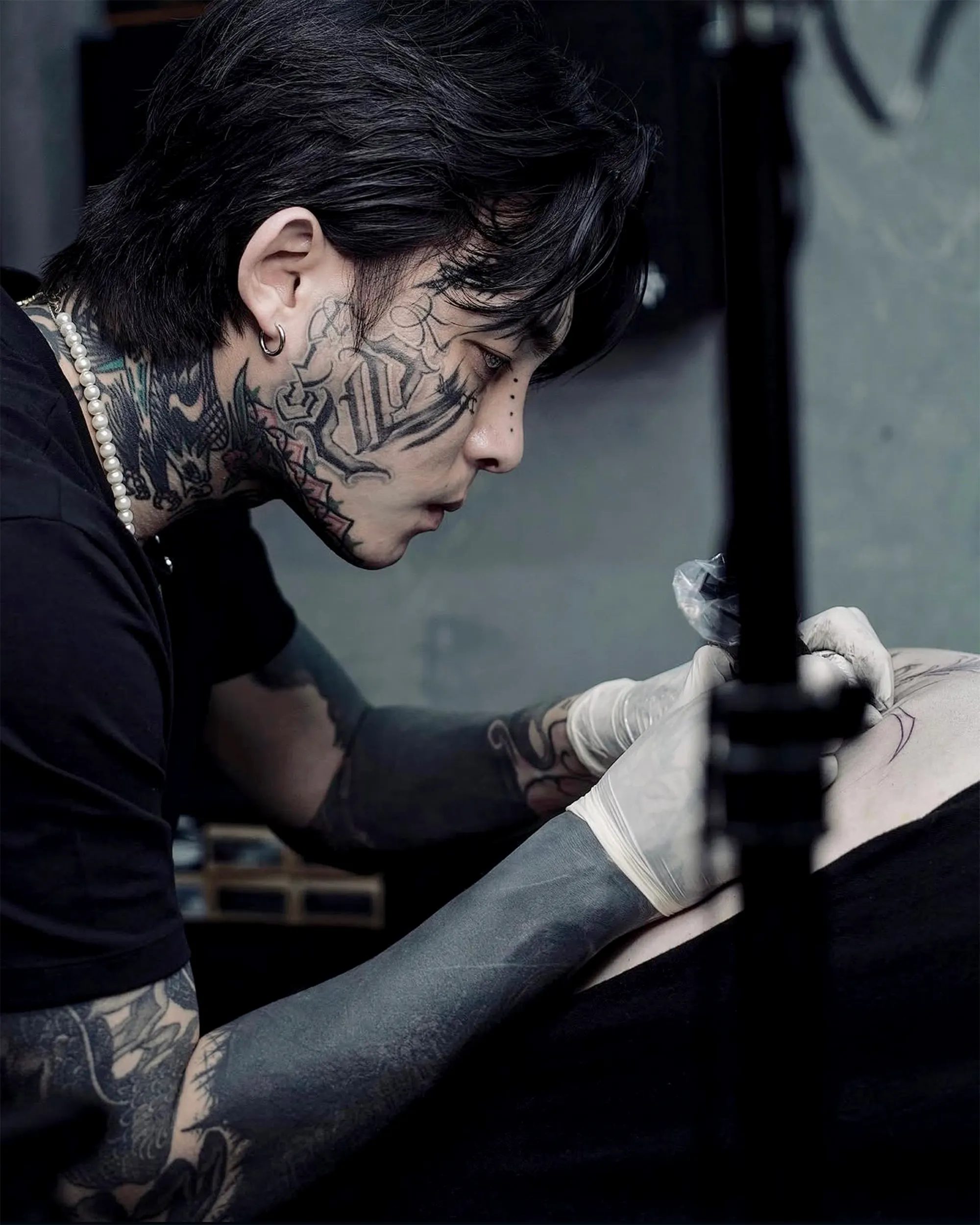
Baegi in his environment at Frame Studio, photographed at his old location in Hapjeong, Seoul.
Baegi spent his childhood with his beloved grandparents in Gangneung, but life changed deeply when they both passed away in his mid-teens. Left to navigate the world alone, he showed immense strength by working to support himself through those early years. At seventeen, he relocated from Gangneung to Seoul, allowing him to build a new chapter and eventually start a tattoo career there in 2015 at nineteen years old.
That same year, Baegi met Uncogrim through a Facebook group for aspiring tattoo artists. “That connection has kept us working side by side ever since,” Baegi explains. Today, they run Frame Studio together in the city.
Much of the time is spent co-running the busy studio. Regarding artistic influences, Baegi leaves the work open to interpretation. He does not disclose whether designs are guided by the Suminagashi ink-in-water aesthetic or the natural patterns of flowing streams. He considers monochrome the most natural approach. Tattoos are done exclusively in black ink, reflecting also his preference for plain all-black or black-and-white clothing. Although the art appears spontaneous and abstract, the process is intentional. A draft always precedes the freehand work. Each design is tailored to the client through close collaboration during every session.
Beyond his tattoo work, this feature explores Baegi’s personal style, which is praised online, public reactions to heavily tattooed artists in Korea, and his favorite movie character. It also highlights his passion for experimental mixed-media art and the story behind his fascination with the Triumph Thruxton motorcycle.
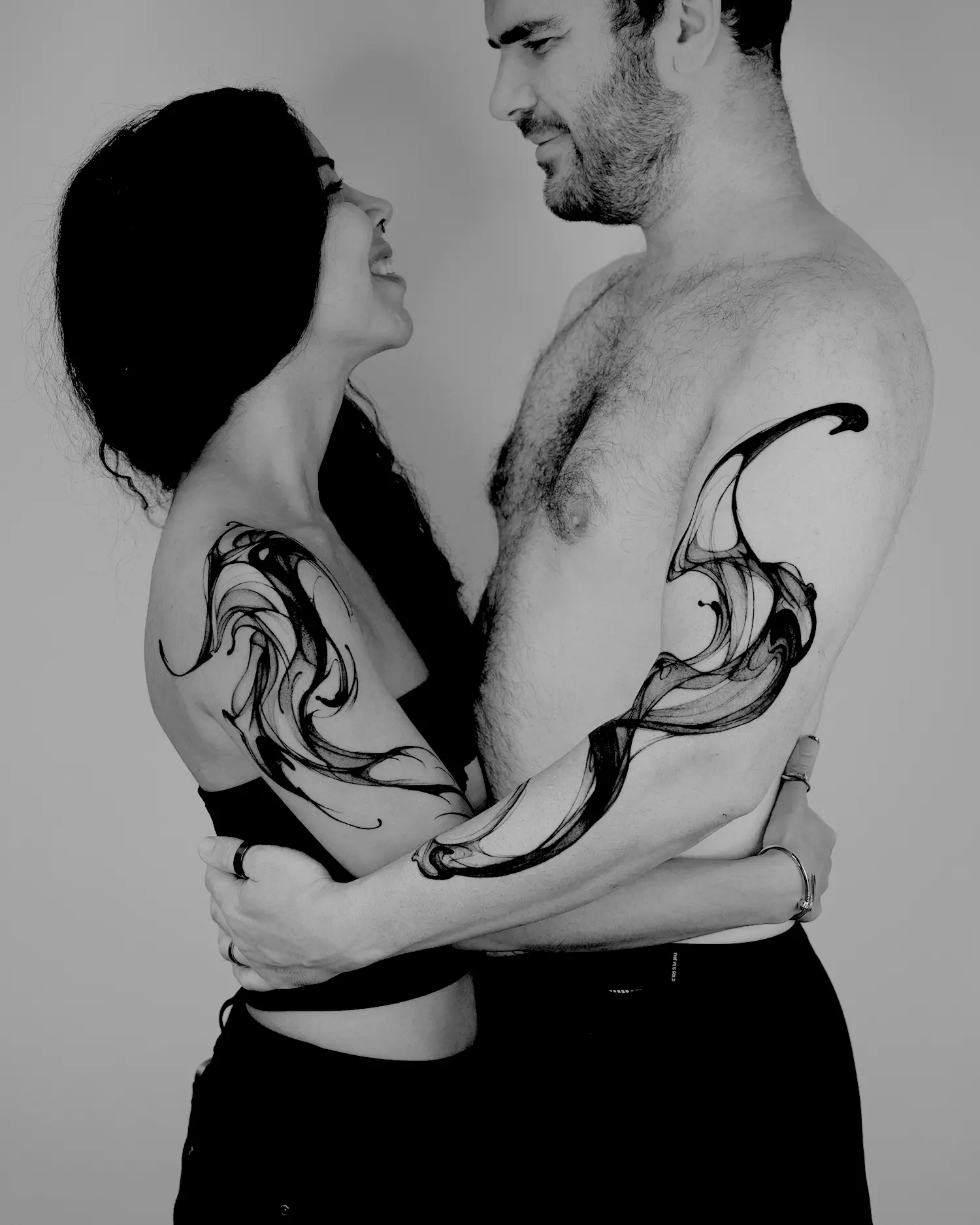
Instead of identical tattoos, the artist suggested a split design. Each person got a unique part that, when combined with the others, forms a complete image. They loved it!
You were born in the seaside city of Gangneung but have called Seoul home for a long time now. Do you still feel that being near water is essential to you?
Yes, I 100% think so. I feel that the faster and busier a city is, the more it needs to blend with natural surroundings. On nice days, I usually go to the Han River alone and lie down.
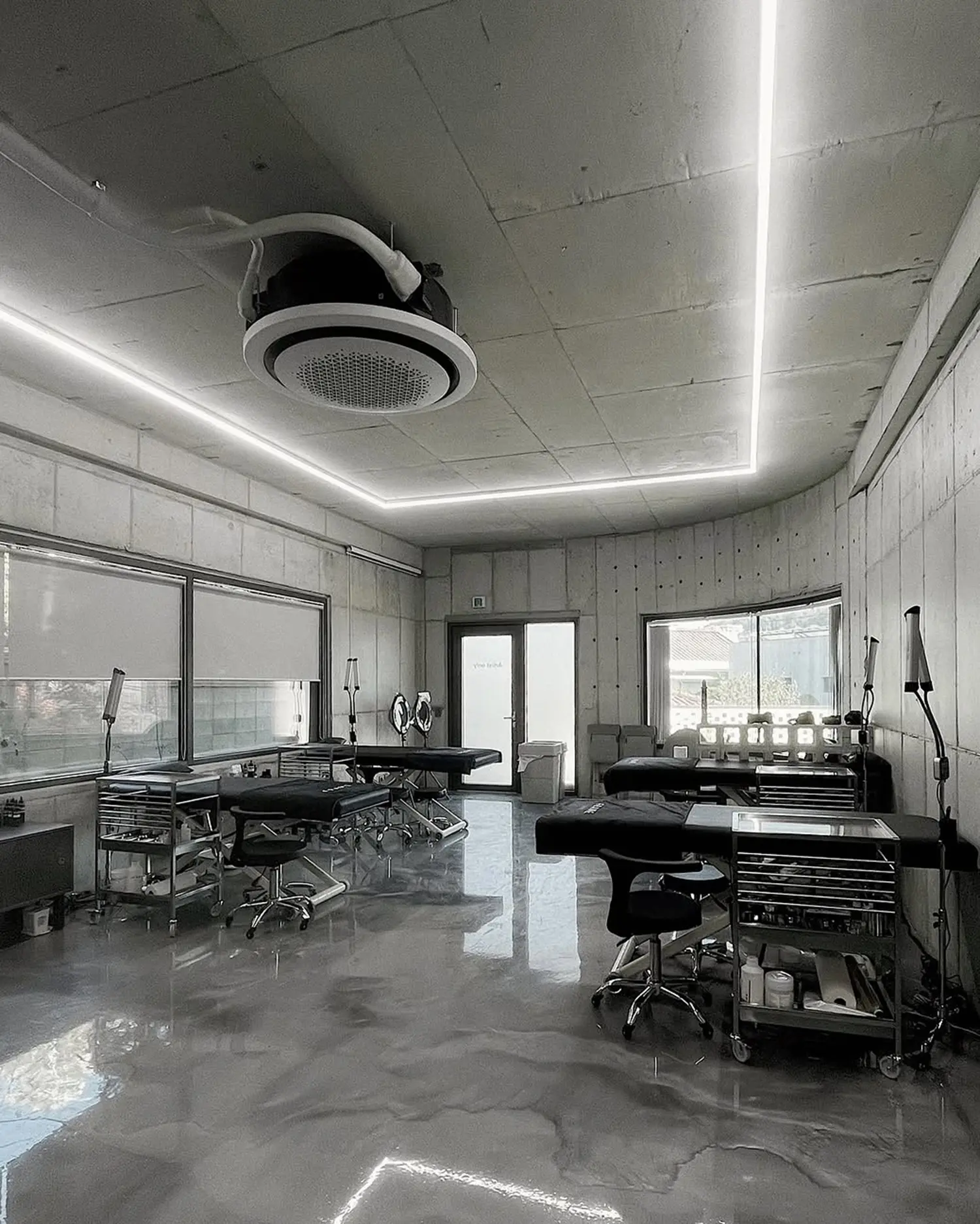
The inside of Frame’s new, more industrial-looking studio in Yeonhui-dong.
What is the area like around your studio, Frame, in Yeonhui-dong?
It is located next to the vibrant Hongdae and Yeonnam areas, but it has a quiet, clean, and peaceful charm.
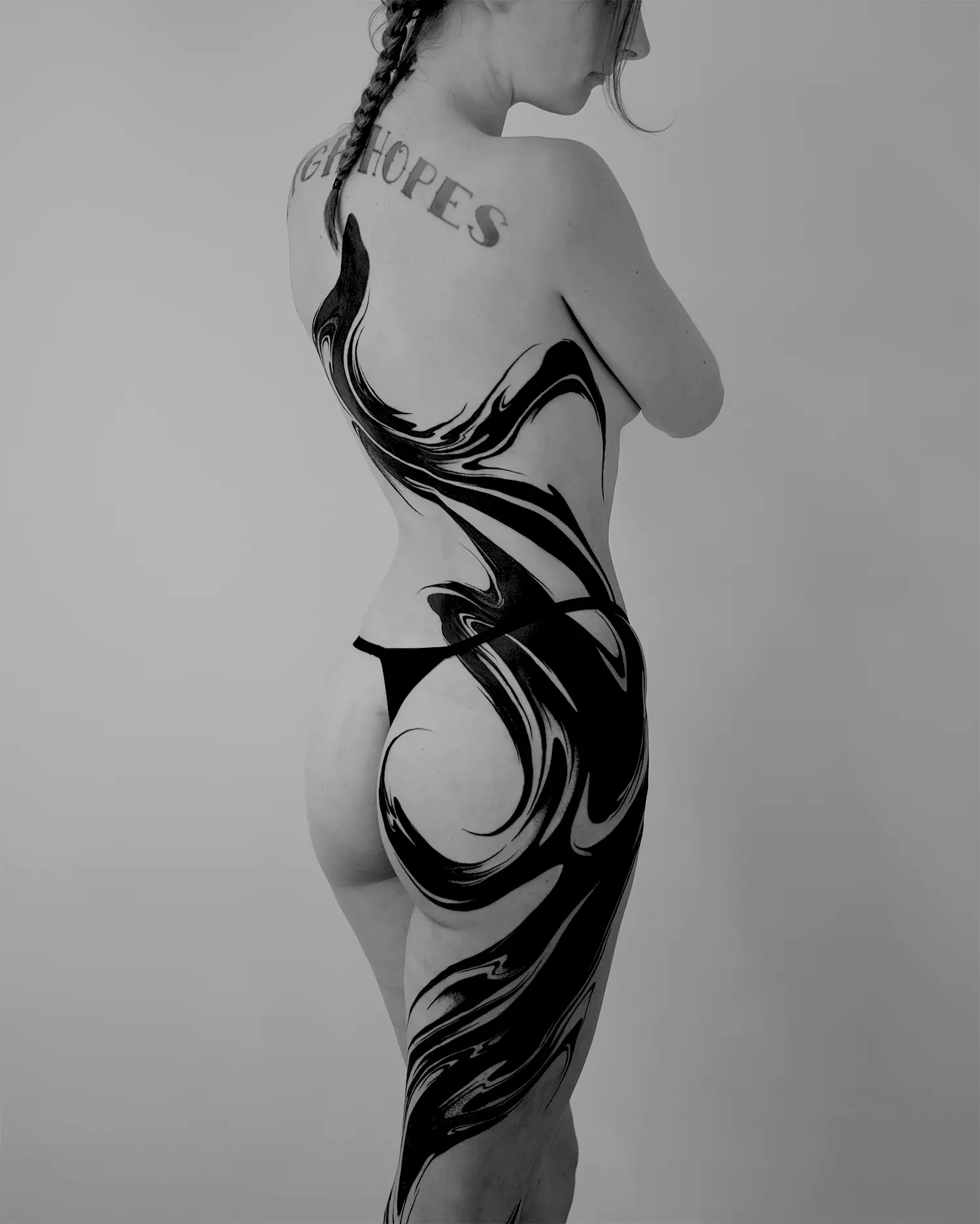
Undeniably appealing, the collector placed her full trust in Baegi, who effectively managed the ink and composition so it circulated smoothly.
What year did you open your shop, and how big is it?
It was in 2019—it’s wild to think how fast time has flown. The studio is around 66 square meters (about 20 pyeong), and it’s currently home to three artists—myself, Uncogrim, and Zitten.

Pouring resin and colorants on canvas, Baegi crafts mixed-media art that mirrors crashing waves and sea foam.
You have a lot of talent at your studio!
Thank you for the compliment. Each of us pursues slightly different aesthetic details; we naturally complement one another’s blind spots. Zitten mainly focuses on subjects like flowers or East Asian traditional art, building details with delicate, fine lines. Uncogrim’s work mostly revolves around snakes or dragons, exploring ways to express them in a classic direction. We constantly bounce ideas off each other while working. I may not be the best at expressing my feelings in words. Who knows what the future holds, but as we navigate the ship called “Frame” together, I’m deeply grateful for them and hold this connection dear.
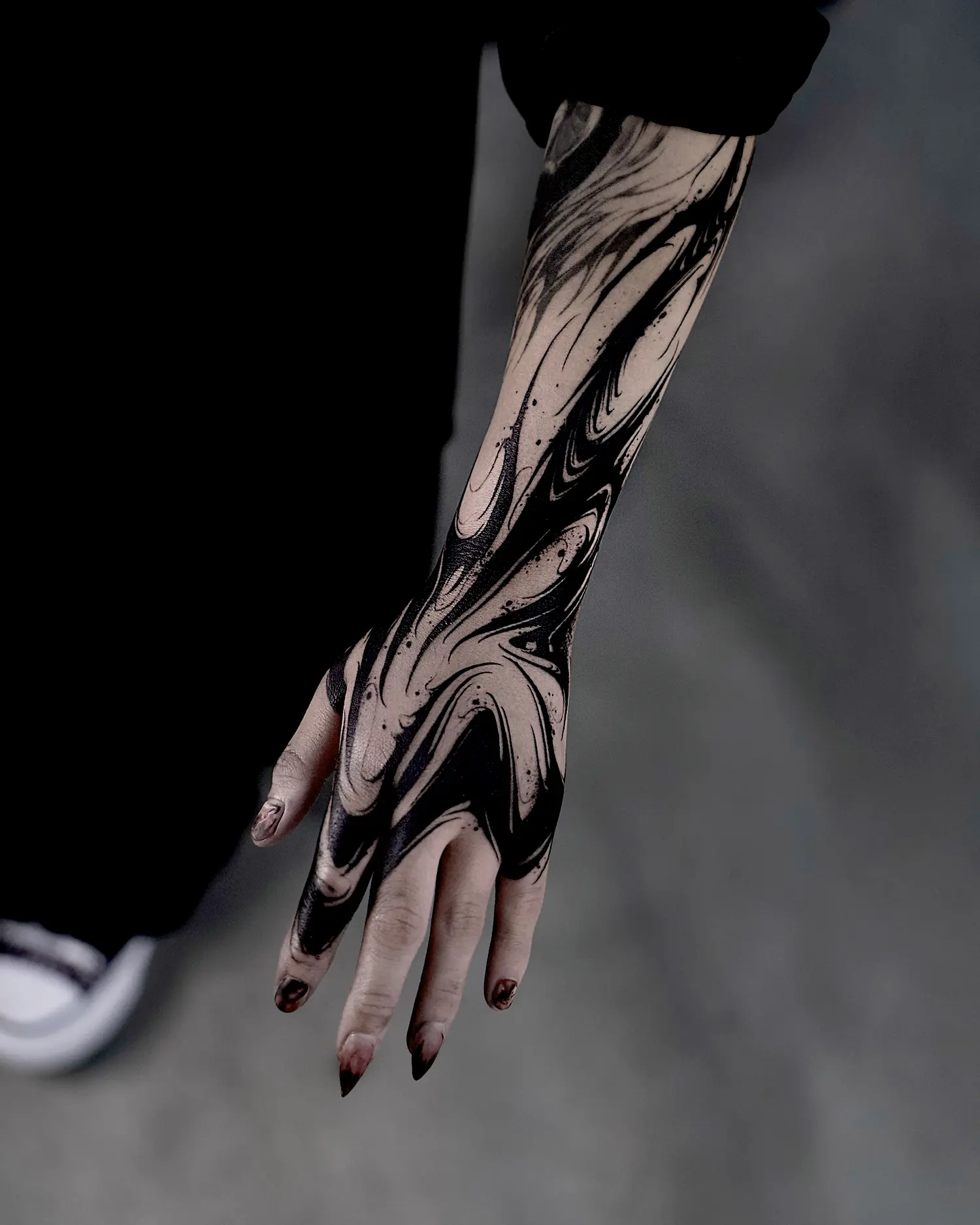
An unwavering collector traveled all the way from Japan to get a tattoo in South Korea. They have worked on six projects in all, and this is one of them.
How does your heavy blackwork style affect the way you approach cover-ups?
Clients might think it’s easy to cover up, but there are limitations and challenges. Cover-ups work best when the tattoo’s size isn’t an issue because I can design over a broader area to create a natural flow and transition. It requires adapting my vision. Compared to blank skin, it is better without restrictions or obstacles. This lets me express an original idea from start to finish much better.
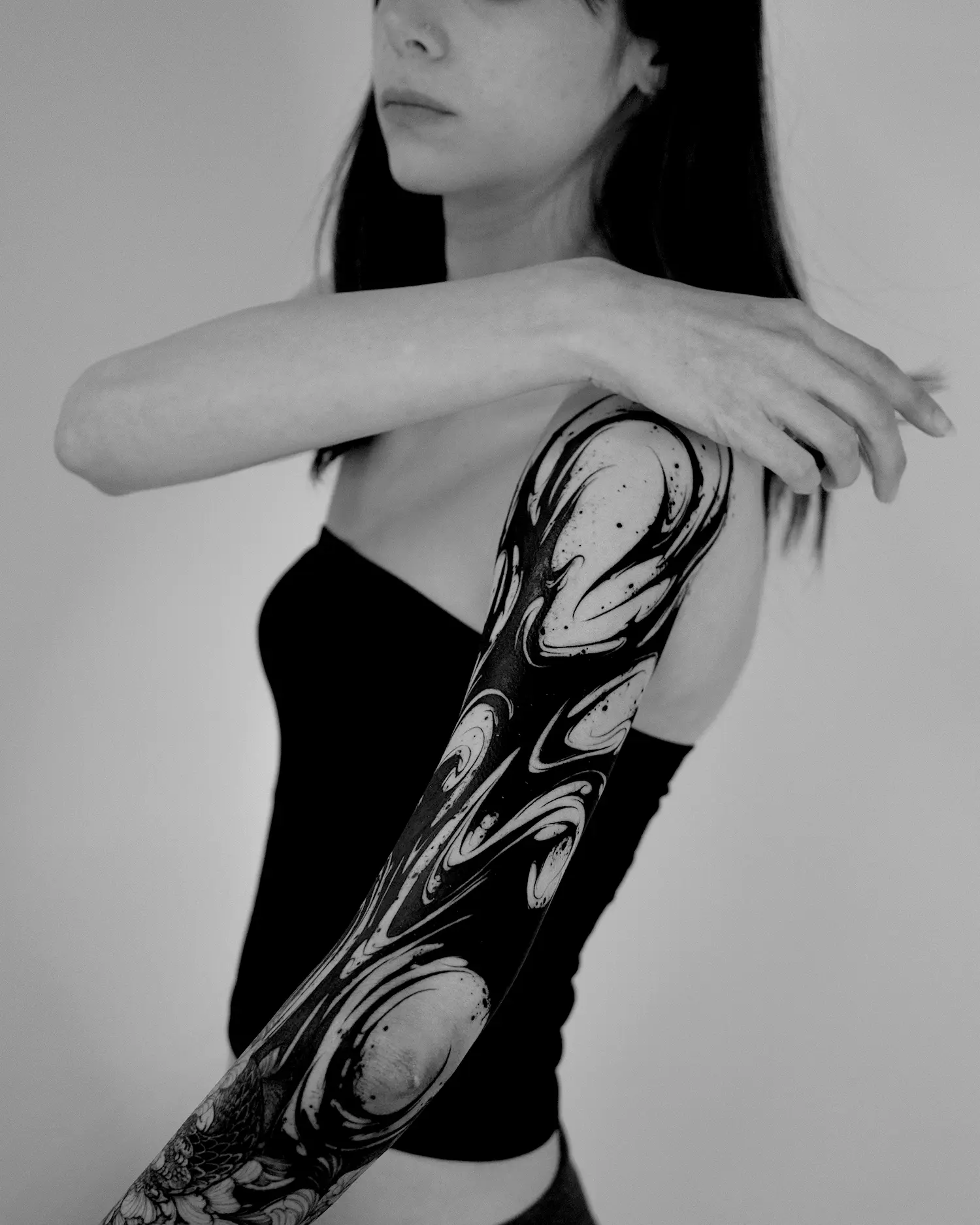
The unexpected bottom of the arm was done by his friend @Khalblk. Baegi then continued it to complete a full sleeve, uniting the old with the new.
Your Instagram followers love your personal style. Do you get that same reaction walking the streets of Seoul?
I’m grateful for that. In Korea, exchanging casual greetings with strangers on the street isn’t part of daily culture, so it doesn’t happen often here. I usually experience those spontaneous interactions more when I’m traveling abroad.
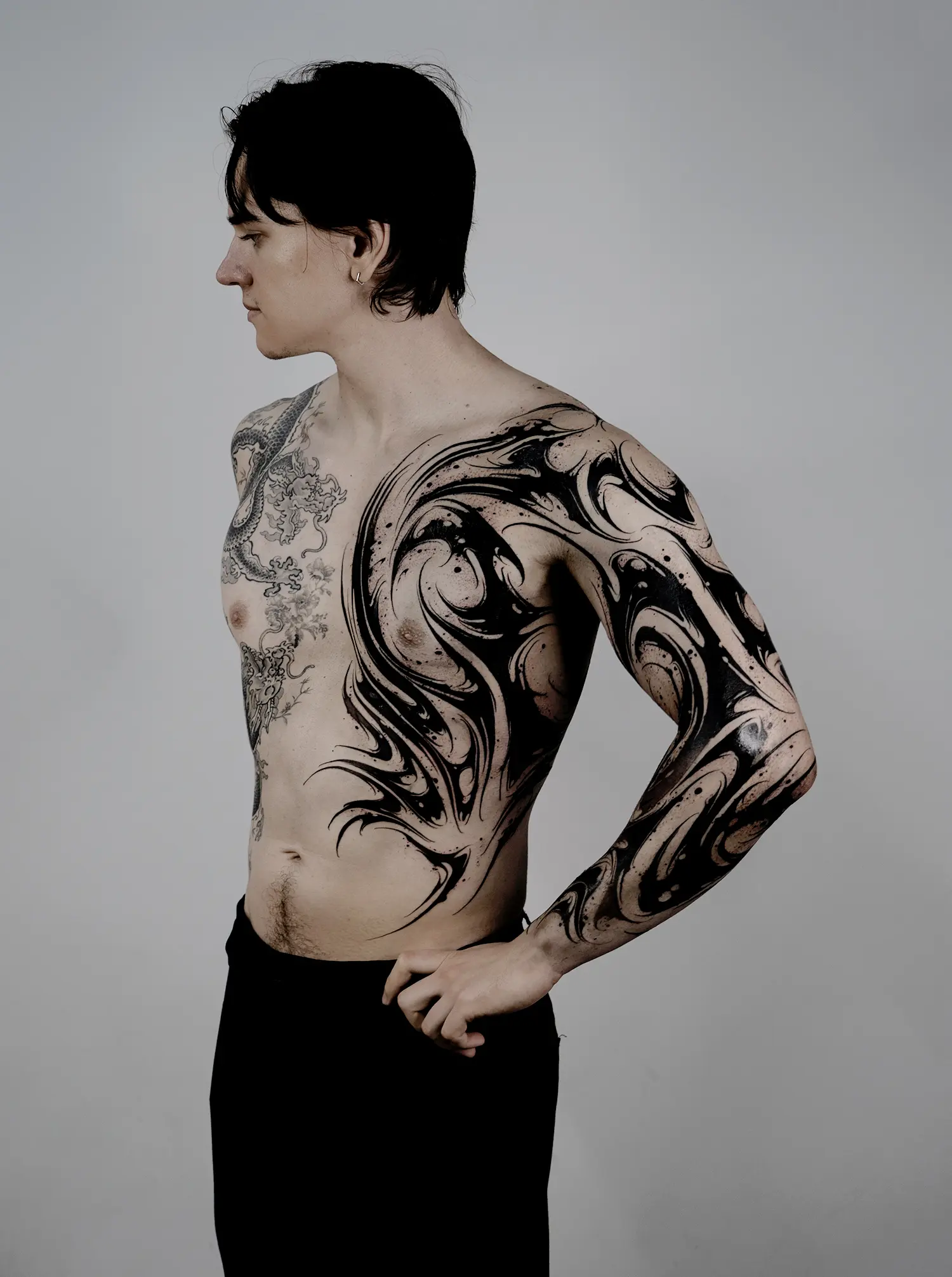
Client who got tattooed 3–4 years ago. Due to his chest tattoo, visual symmetry was the goal—two days of linework in Paris, then six in Korea.
Who tattooed your face, and do you ever experience backlash or prejudice?
They were done over time by many artist friends. I would say it was youthful boldness, and I accept any judgment that comes with it as part of my choices. I don’t pay much mind to it, and since my daily life and work revolve around a subculture-friendly area, I rarely face real issues. That said, I’m fully aware that outside judgment exists.

This mixed-media creation uses fluid motion to evoke a turbulent waterfall or rushing current.
Your mixed-media pieces have that same dark tattoo flow, but with much more texture and complexity. What do you use to produce them?
I love creating things, so I paint and sculpt casually as a hobby. I experiment with acrylics, resin, plaster, rubber, charcoal—pretty much any medium that can bring out the texture I’m aiming for. I want to keep broadening my artistic spectrum. I’ve participated in a few art shows in the past, and once I feel fully prepared, I definitely have the ambition to do more.
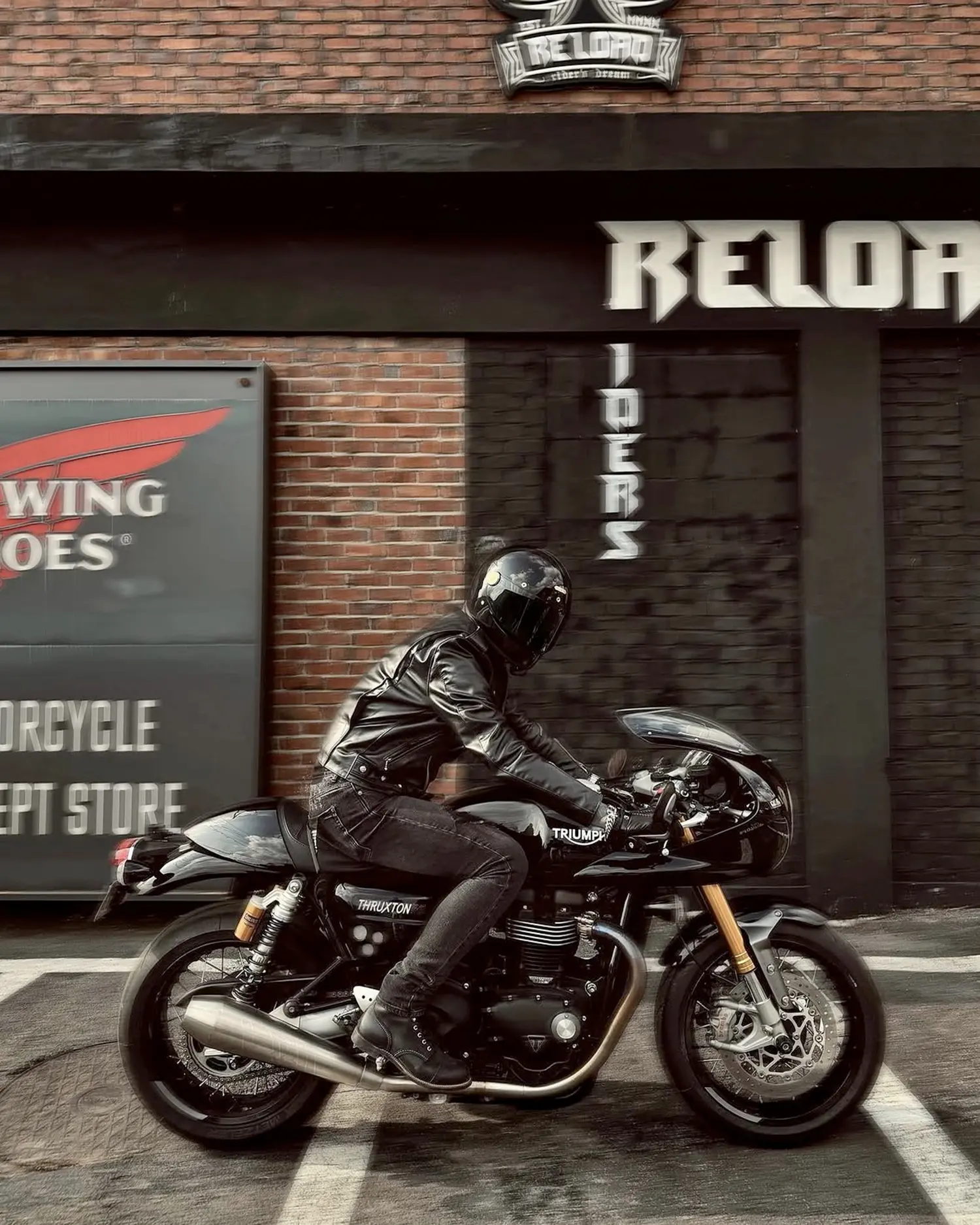
On his motorcycle near a café in Paju, Gyeonggi-do, which is near Seoul. The picturesque mountains and rivers make it an excellent area for a ride.
When you’re not art-making, you’re out on a motorcycle. What draws you to being on two wheels?
Navigating Seoul’s heavy traffic is so much smoother on two wheels—plus, it just has that timeless appeal. Everyone on our team of close friends rides a Triumph. While we occasionally take group trips, I mostly enjoy cruising through the city solo to clear my head.
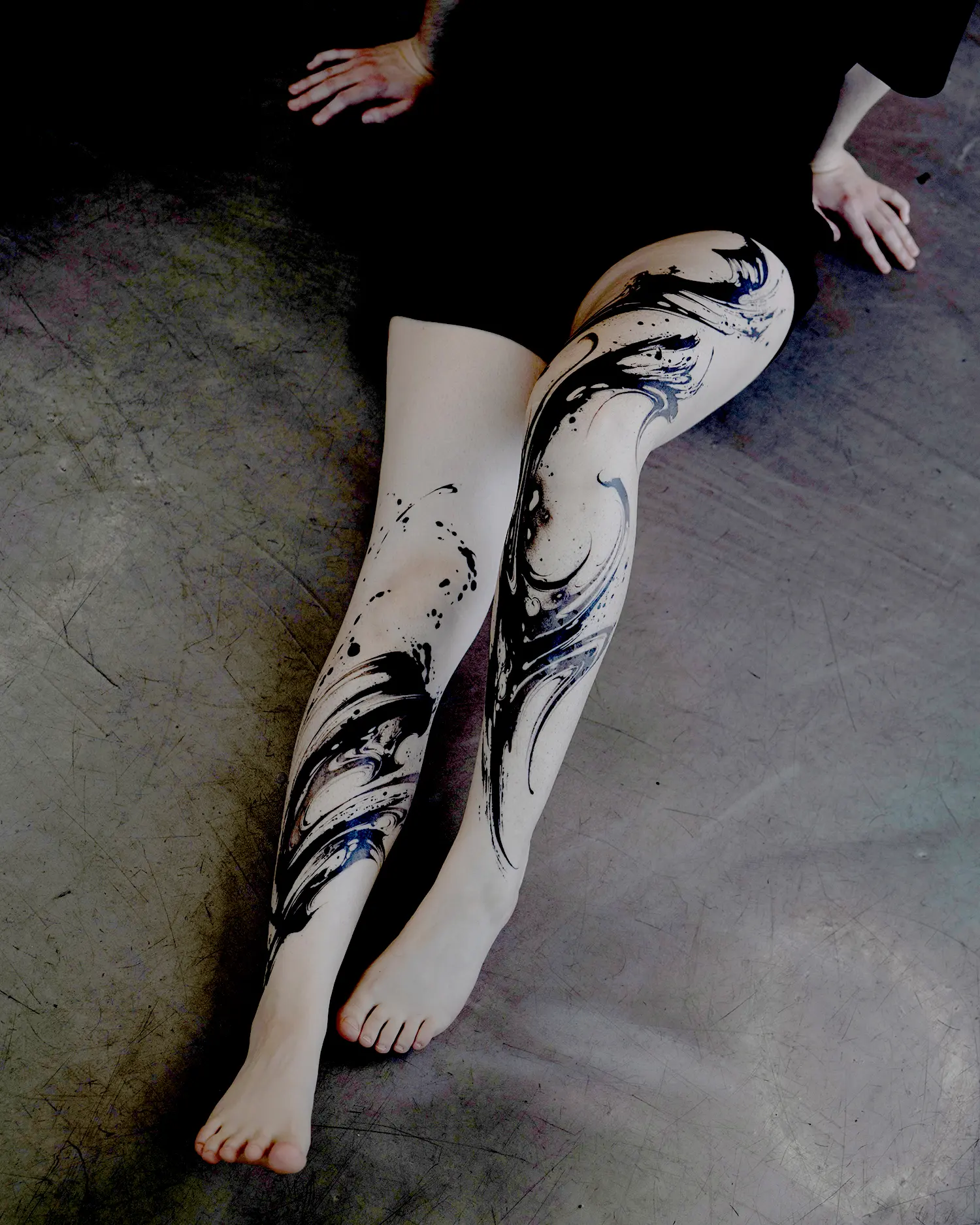
The client mentioned an artist whose brushwork they found inspiring. The body is interwoven with emotive brushstrokes—the whole process required six sessions.
To shift gears for our final question: if you could step into any movie, what fictional character would you play?
That’s a fun question! I thought about it, and I’d go with Will Smith’s character in “I, Robot.” [He is an AI-skeptical Chicago police detective named Detective Del Spooner in the year 2035.] I think I was drawn to living with firm personal values in an era when [technology and society’s rules] are changing.
Photos © Baegi