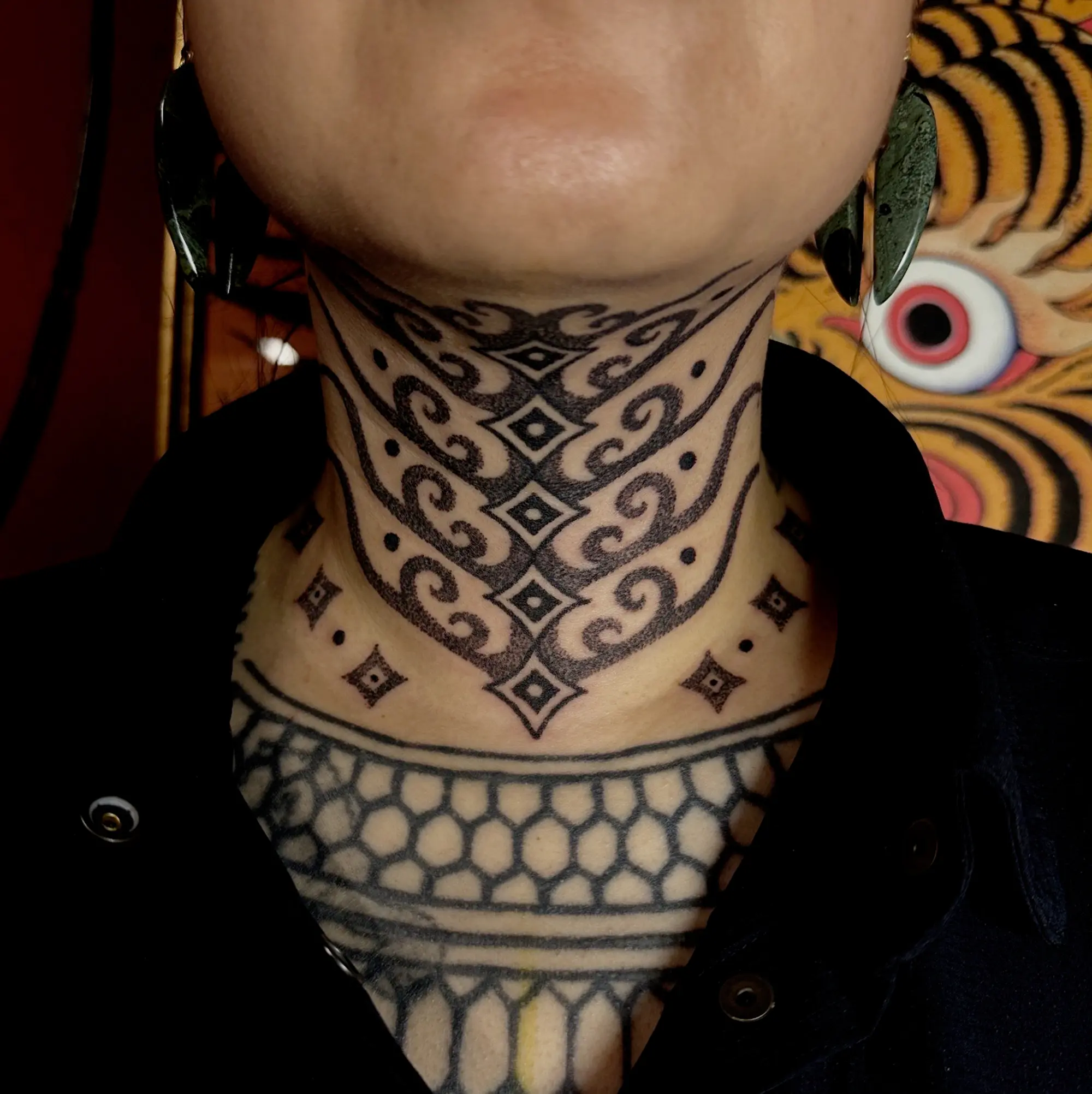
An adaptation and customization of a Parang, a Southeast Asian design with diagonal and often interlocking S-shaped lines.
While the world speeds ahead on current information and technology, Poke Ahontas (real name Iwani Munir) moves with serene intention. The 32-year-old Singaporean tattooer with Javanese roots uses the slow, meticulous handpoking technique, offering each client a meaningful tattoo experience. Drawing inspiration from her heritage, she incorporates traditional Javanese patterns and symbols, such as Batik motifs like Buketan (floral arrangements relating to harmony) and Parang (dagger-like shapes representing strength). Additionally, she finds resonance with other South Asian indigenous traditions, such as Kolam art from South India. Through each tattoo, she honors both tradition and her clients’ backgrounds, artfully bridging personal and collective cultures.
She explains, “About 60% of my work uses stencils, as I do much symmetrical work for frontal projects like the chest, stomach, and sternum.” For smaller areas, such as ears, however, she prefers freehanding and has recently been doing more of it to improve anatomical flow and let designs wrap naturally.
Since 2024, Poke Ahontas has been a resident artist at Sacred Bloom Tattoo in Singapore. Few know she first graduated in Pharmaceutical Science, then in Accounting. Reflecting on her journey, she says, “I spent years on conventional paths before pursuing what I truly wanted.” Once she chose tattooing, everything fell into place.
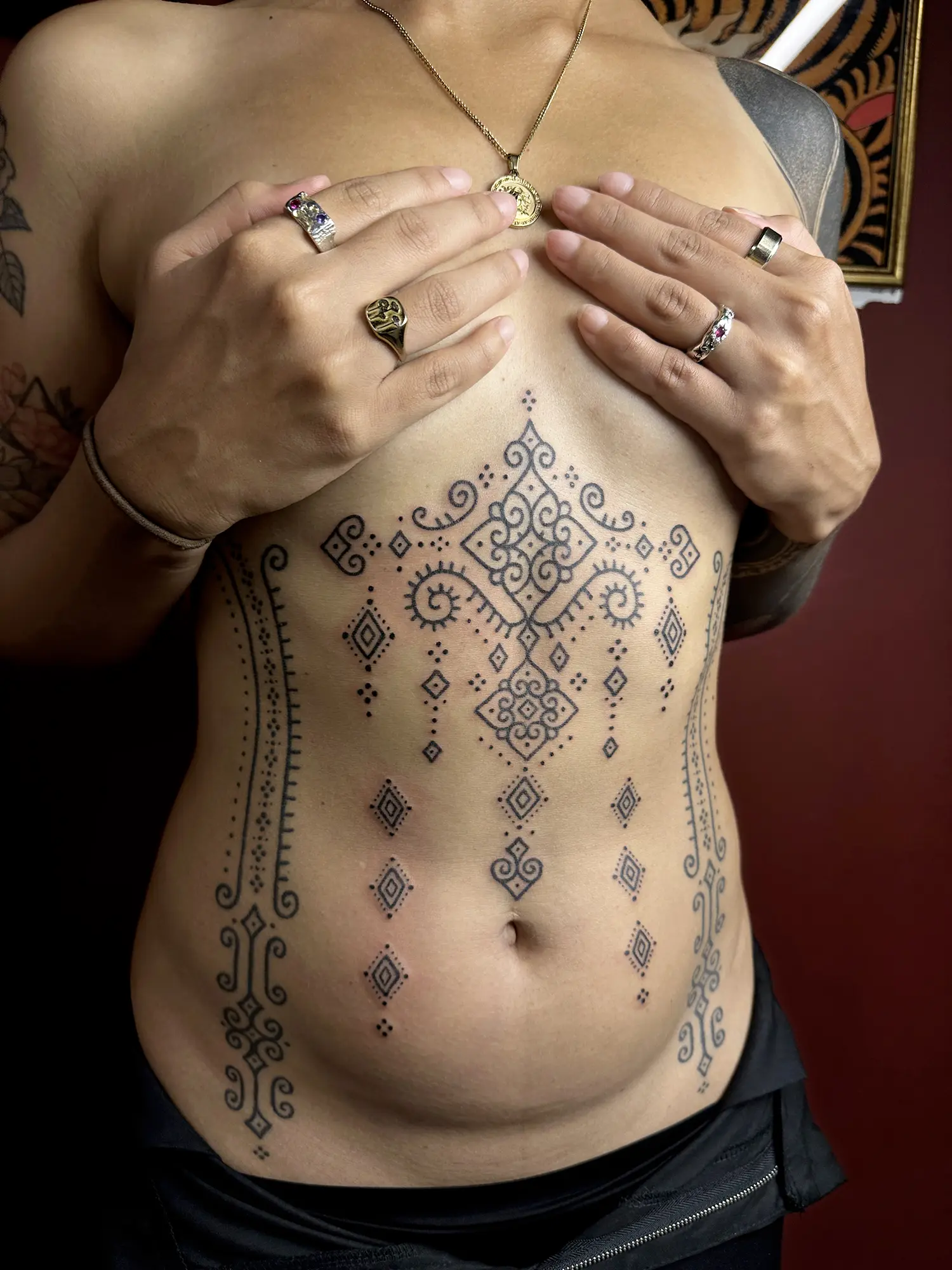
Curlicues and dots. These are based on Tanimbar’s traditional silver earrings.
What inspired you to produce tattoos without using a machine?
I have always been drawn to traditional, machine-free tattooing methods, such as hand-tapping and Tebori. Handpoke offers a more intentional approach to mark-making, especially when creating bold or large-scale designs.
Many of my clients seek out this method for a quieter, more intimate experience, one that is often less physically traumatic, particularly for sensitive placements like the sternum, chest, stomach, or hands. Although the process takes longer, the slower pace creates space for connection and trust to develop naturally over long sessions.
While I am known primarily for handpoke tattooing, I do not limit myself to one method. I offer both handpoke and machine work, sometimes combining the two within larger projects. That said, handpoke remains my preferred approach. The act of hand-tattooing feels meditative to me as there are moments when both the client and I enter a shared flow state, working quietly, dot by dot.
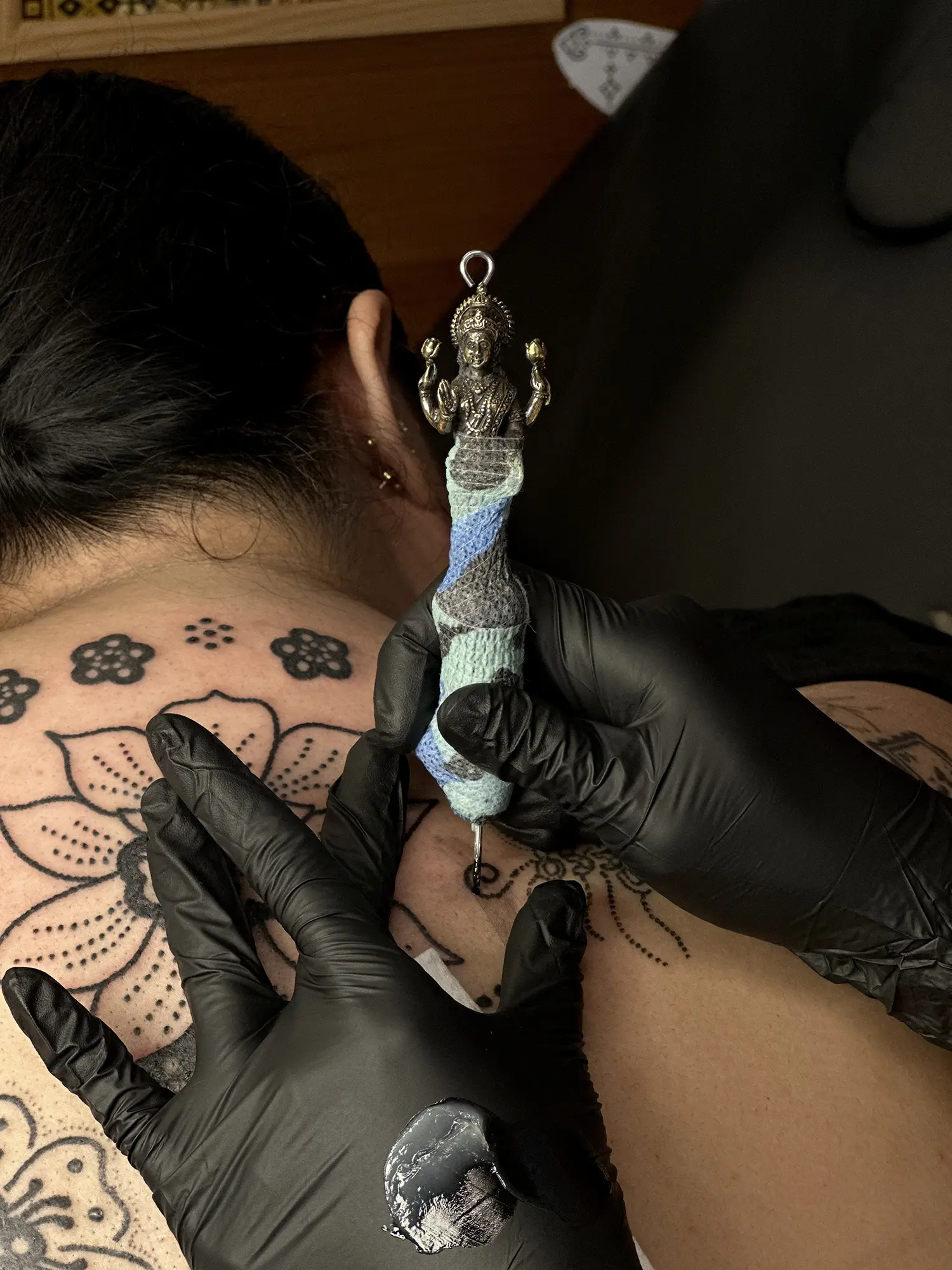
Poke Ahontas applies this handpoke instrument—crafted by Rodolphe Cintorino and depicting Goddess Lakshmi—with a heavier base, which allows for thicker lines.
When you say you feel a meditative state while tattooing, is the whole process peaceful and rejuvenating, and does this impact remain after the session ends?
For most tattoo artists, the stencil process is the most technically stressful part. Once that is done, I feel myself settle. When I speak of entering a flow state, I mean that I become deeply present and attuned to the piece I am creating. My composure remains steady because energy is palpable at such proximity, and clients can sense even subtle shifts. Inner energy mirrors outwardly. For that exact reason, I am mindful not to allow external stress to enter the session. The atmosphere I hold directly shapes the client’s tattoo experience with me.
If a client begins to feel overwhelmed by pain, especially in more tender areas like the sternum, I lean in with encouragement and empathy. I guide them through breathing techniques and encourage breaks when needed. With handpoke, however, the slower rhythm often allows clients to remain surprisingly relaxed. Of course, this would depend on the placement as well.
After a session, I usually feel grounded. Being fully present requires energy, but it is also what sustains me. Awareness of the energy I give and the energy I absorb keeps me intentional. The sort of presence is what continues to drive my practice.
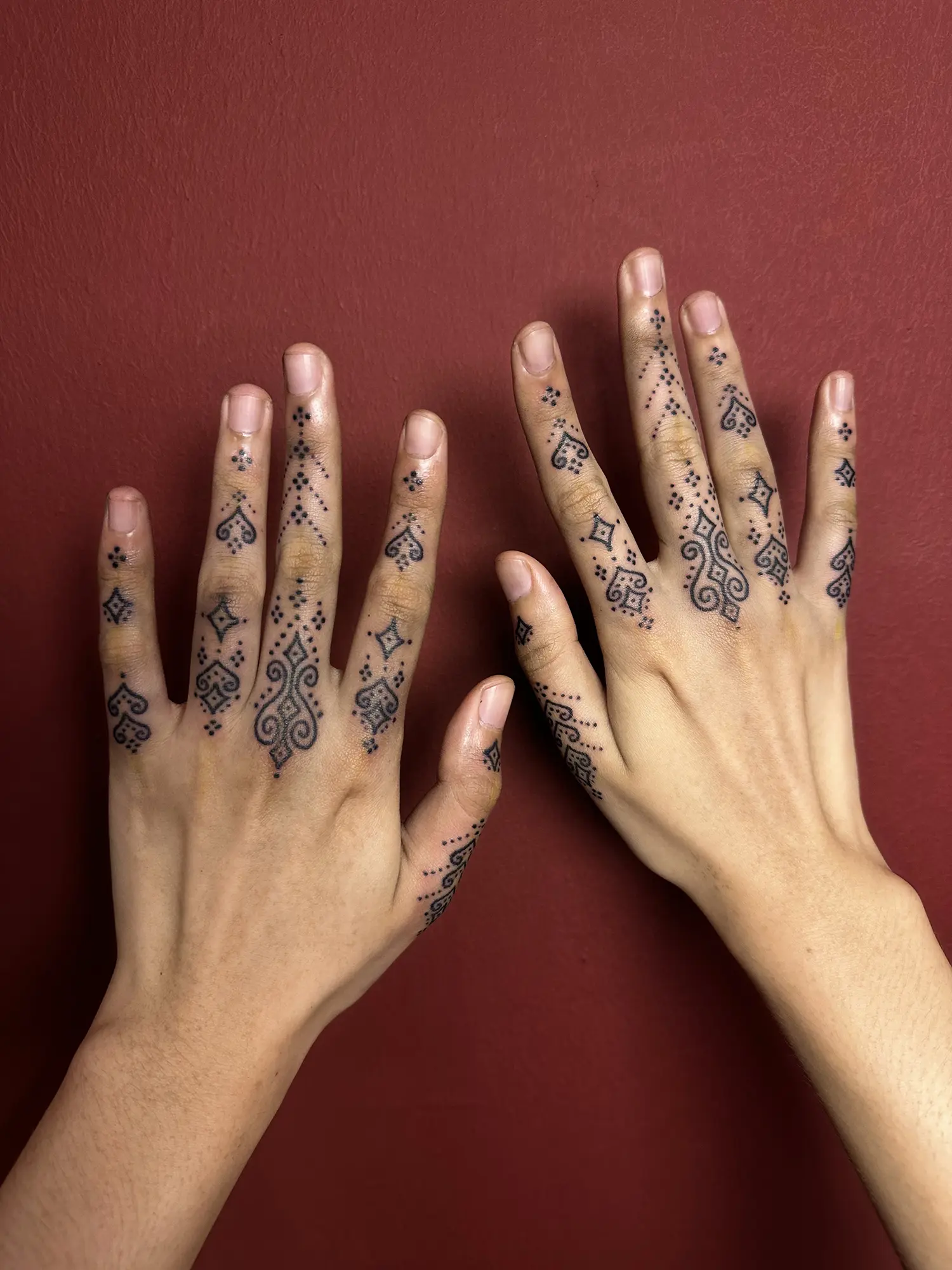
This ornamental work was influenced by traditional West Timor and Tanimbar (Southwest Maluku) jewelry, particularly spiral and dot motifs seen on combs and earrings.
Also, expand on the spiritual aspect of handpoking.
Handpoke tattooing requires time, patience, and prolonged closeness, which naturally creates a shared energetic space between the client and me. Because of this, I only take one client per day, even for smaller pieces. I approach each session with intention.
I hold deep respect for indigenous tattooing traditions, where marking the body was part of ritual and cultural continuity. Handpoke is my way of honoring those histories and carrying forward a slower, more mindful approach to tattooing.
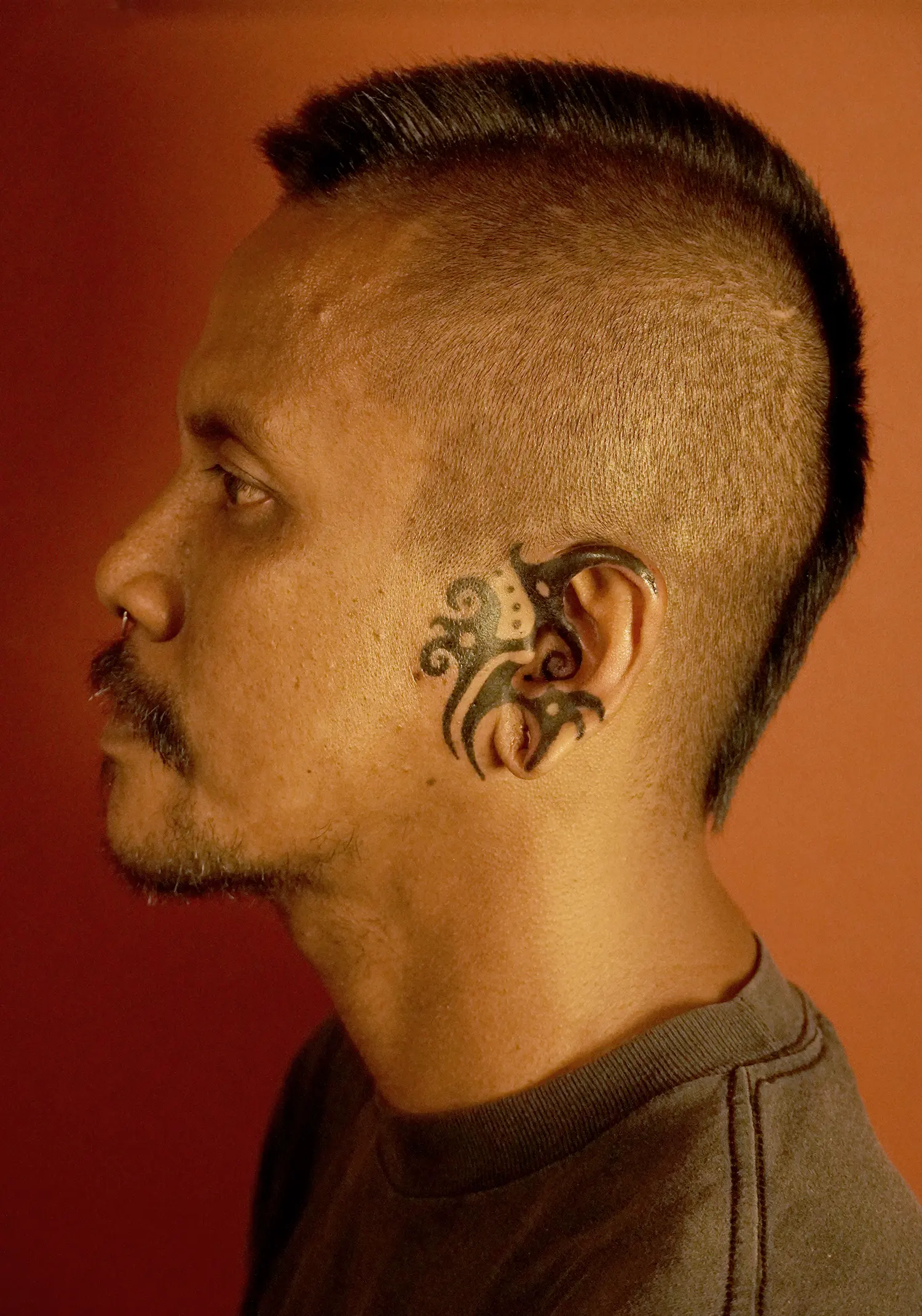
Poke Ahontas’ freehand Bornean tribal tattoo.
Southeast Asian textiles influence you. Explain the actual locations and symbols where the motifs are often found.
Most of my work is derived from Indonesian textiles like Batiks and Ikats, patterns/motifs from Borneo, and sometimes even ornaments on trinkets like Sirih (Betel Leaf) boxes. My inspiration comes a lot from books, as I spend a lot of time at the library looking for references and finding inspiration for my work. I pay close attention to the pattern work and the flow of these motifs/floral patterns, and they are what mostly inspire the designs of my work. Being ethnically Javanese, I keep in touch with my roots by drawing on them as an influence in my work. They don’t come from a single location, as Batiks can often be derived from many parts of Indonesia and are influenced by Malaysia and other parts of the Nusantara. An example would be patterns like the Parang motifs found on a type of Batik, which was once forbidden to those outside palaces because it was the mark of court Batiks worn by kings and their offspring. On this day, these restrictions are more relaxed, which inspired my use of this particular motif and the modernization of the design.
Even the dots, diamonds, and floral patterns seen in my work are shapes and patterns you can find in these many different textiles. Sometimes they are not even noticeable unless you look closely.
I have clients who bring in Batiks or trinkets passed down to them by their late grandmothers, and they want the patterns turned into tattoos. I take great pride in preserving the essence of the patterns on these very sentimental items and in designing them. Hence, making them simpler and easier to read as tattoos, without compromising the imagery they convey.
It is also very rewarding for me to see a client wearing tattoo art with a deeper meaning, and I would like to continue doing this, as I believe in carrying a part of our roots so they are not lost or forgotten. It is about being proud of who we are and carrying the essence of what makes us, in the form of a tattoo.
Sometimes I do work that may not be derived from Indonesia, but rather patterns like Kolams or folk art. I always take into account where my clients are from and their ethnicity or background, speaking with them more so I can do my part in the research and integrate elements into the design that show a part of their roots in their tattoos.
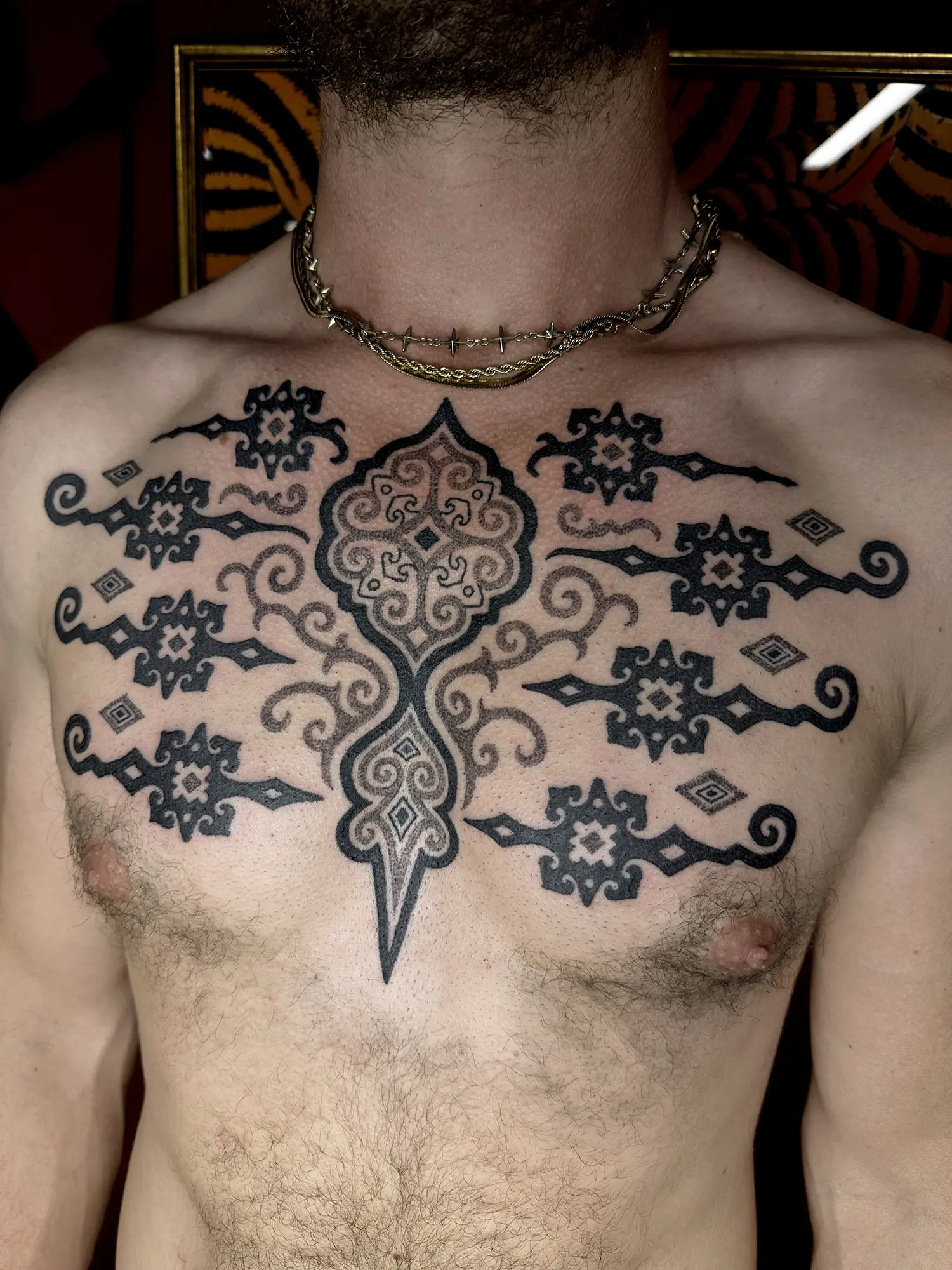
Blackwork with a protective pattern reminiscent of East Sumba, Borneo, and Toraja fabrics.
A low-stimulus environment offers many benefits. Does your breathing change throughout the session?
I do notice a shift within myself when I enter a flow state. My breathing steadies, and I begin to move in rhythm with my surroundings, the music in the studio, my client’s breath, and my own. A quiet synchrony develops. At the beginning of each session, I usually initiate conversation as it serves as both a gentle distraction and a way to ease the client into the process. Many clients come in feeling nervous, so I ask about their week, how they have been, and who they are outside of the appointment. It eases them into the experience and also allows them to settle into themselves. I find that when they feel seen and heard first, their body softens more naturally. Individuals with a more spiritual or introspective background often sit especially well for handpoke. Because the method is slower and more deliberate, it invites presence. Allowing the process to unfold without rushing, it becomes intentional rather than transactional.
After the first session, most clients tend to arrive more relaxed because they know what to expect. In subsequent sessions, there are often prolonged periods of silence. Sometimes they drift into their own thoughts, other times they come prepared with a playlist or podcast. I allow the nature of each session to unfold organically. I don’t force conversation or silence.
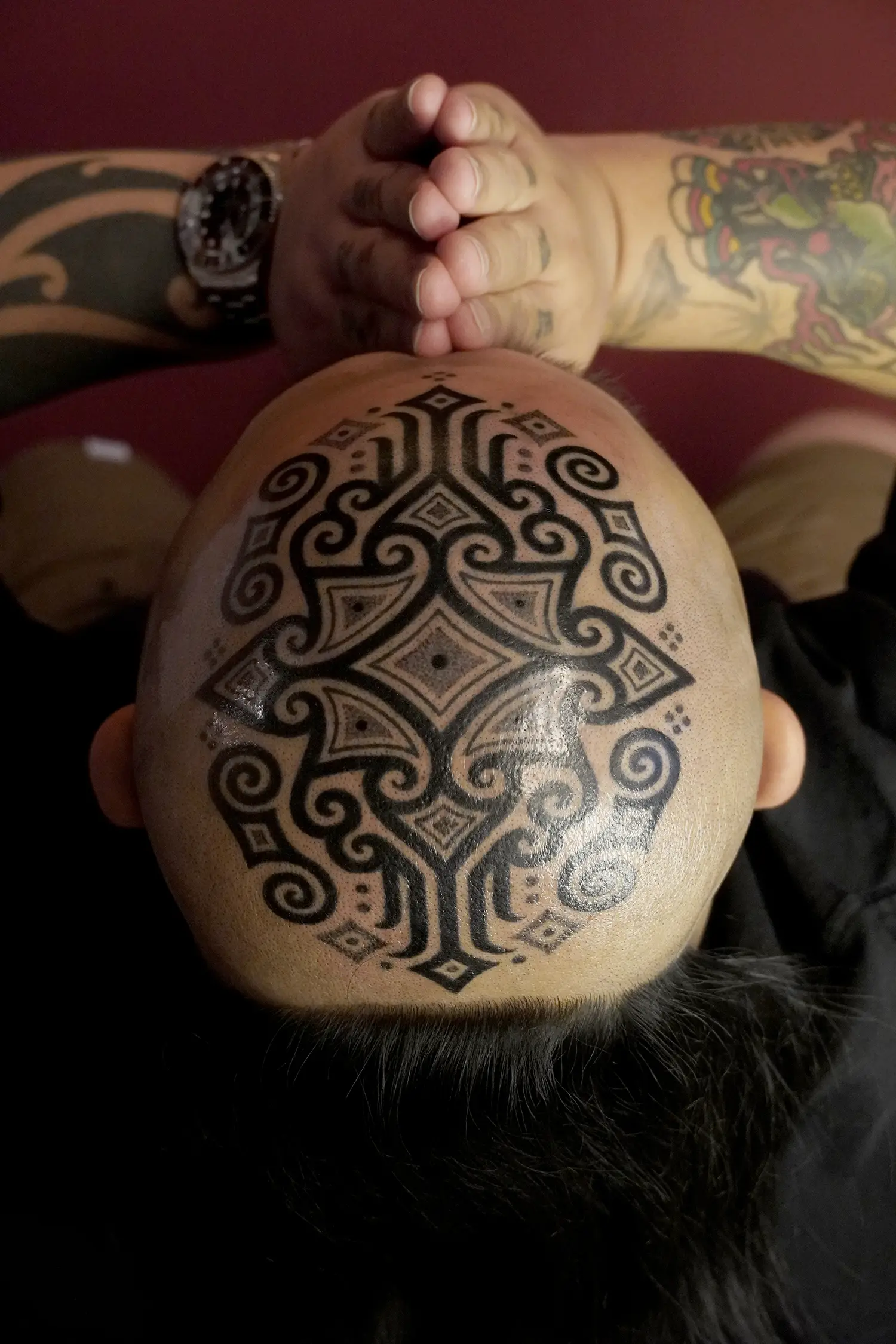
A three-session tattoo; the first two were spent laying up the stencil and then refining the lines, as Poke Ahontas spends the most time on the details.
Perhaps the “medicine” for today’s societies is to decelerate and live with a greater purpose.
Many people are beginning to question the sustainability of hustle culture, especially in fast-paced environments like Singapore. A life built purely on speed and productivity eventually demands a cost.
For myself, choosing a slower pace has been an intentional decision. I prioritise exercise, reading, spending time away from my phone, and creating without pressure. Even small things like having coffee or tea in the morning, sketching when an idea comes to me, or going to the beach to put my feet in the sand help me to feel grounded. Reducing time on social media has helped me to focus on refining my craft without constant comparison. Slowness is not stagnation; it is depth. It allows me to give space for creativity and mental clarity.
I’ve noticed that many younger Singaporeans are seeking quality of life over quantity of output. They want more than just financial success. They also seek quality of life, meaning, and balance. Is this a slower return to tangibility “medicine” for society? I cannot say with certainty. But I do believe that reconnecting with the body, with nature, and with intentional craft is a powerful antidote to disconnection.
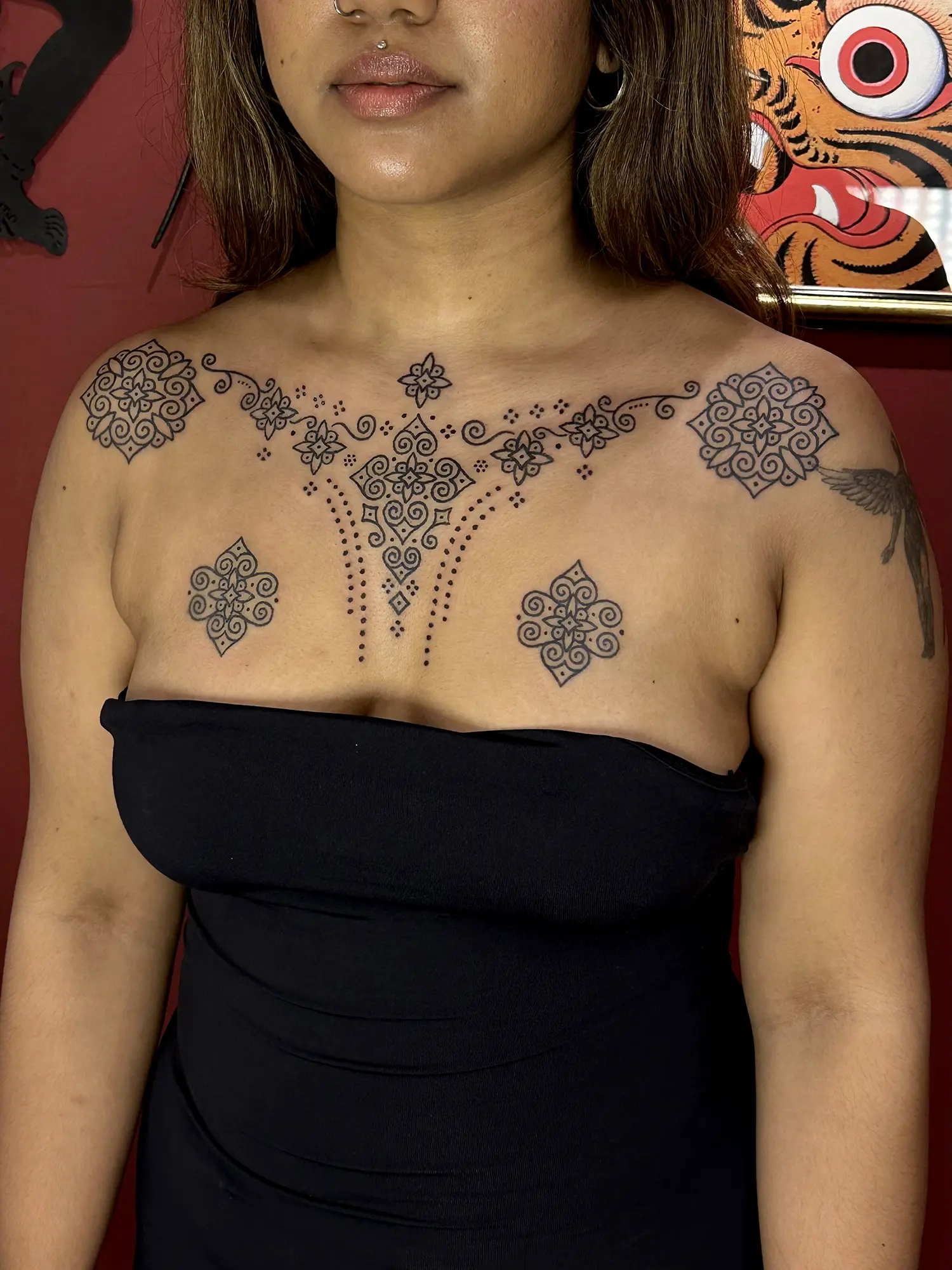
The sides were finished first, and the middle was completed a half-year later. Diamond embellishments, which are commonly utilized in Batiks and Songkets, and recurring in the tattooer’s portfolio.
In reference to tattoo conventions. How many do you attend every year, and what criteria do you use to choose an event?
I primarily participate in tattoo pop-ups and collaborative events in Singapore, which I’ve been doing since around 2023. For example, I did a customization project with Vans and an artist talk at the National Gallery Singapore.
I began attending conventions in 2024 and currently average one to two per year. My first was the Malacca Tattoo Convention in 2024, followed by the Pharaoh’s Horses Invitational in 2025. I prefer smaller-scale, more intimate events over large commercial conventions. I value spaces where I can have meaningful conversations and genuine exchanges.
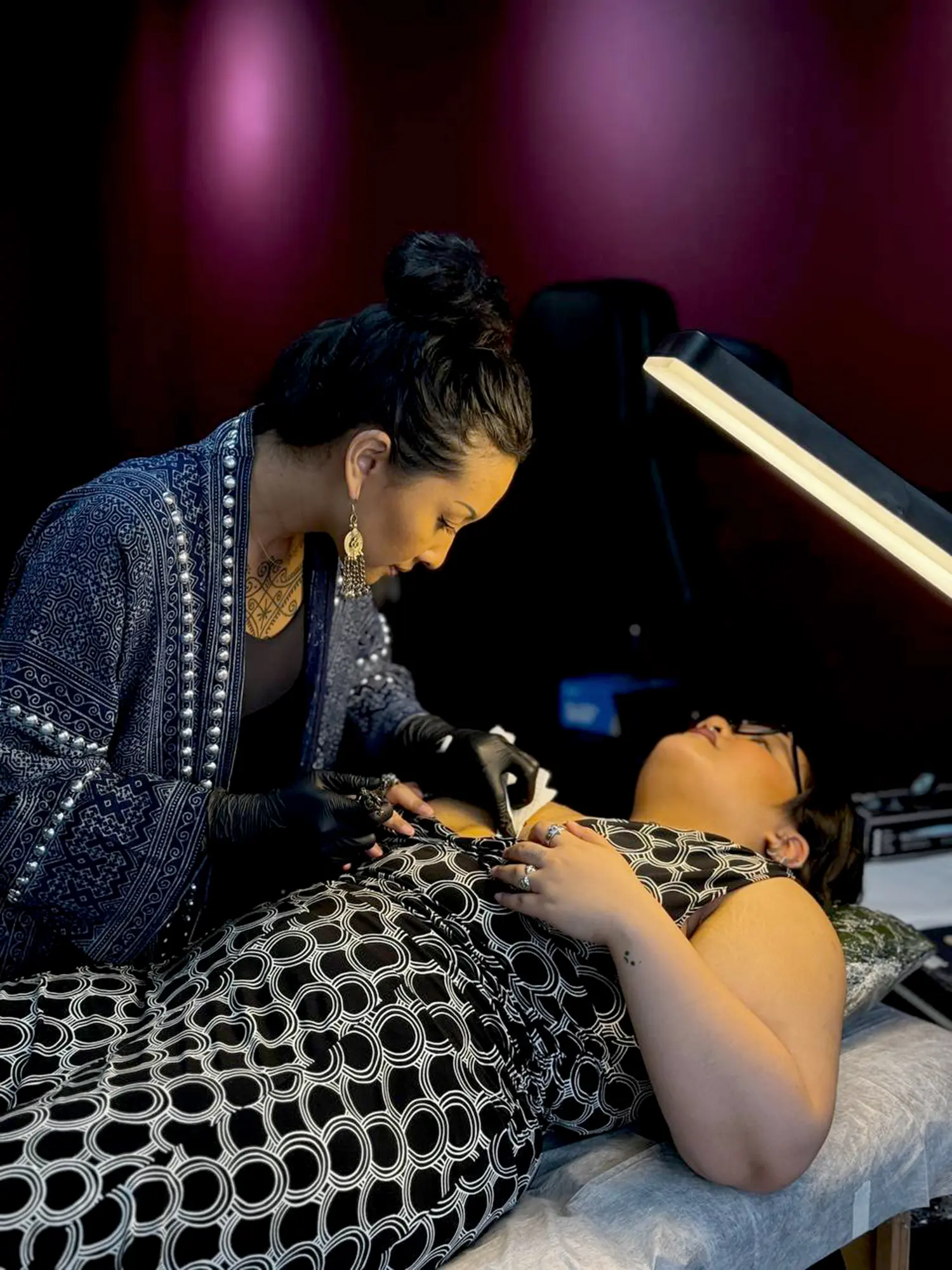
Poke Ahontas is adding small ornated imprints to the sternum of a returning client at Sacred Bloom Tattoo studio.
You also attended Chiangmai Tattoo Time; are there any standout recollections of this convention?
Chiangmai Tattoo Time was a very special experience for me. It allowed me the opportunity to meet artists I’ve long admired, as well as reconnect with people I’ve crossed paths with at previous events or in Singapore.
I’ve attended this event twice now, and each time I’ve made new friends and connections. I didn’t have my own booth on either occasion as I attended mainly to experience the convention, meet artists, and collect work from people whose practices I deeply respect. It felt less competitive and more like a gathering.
Photos © Poke Ahontas