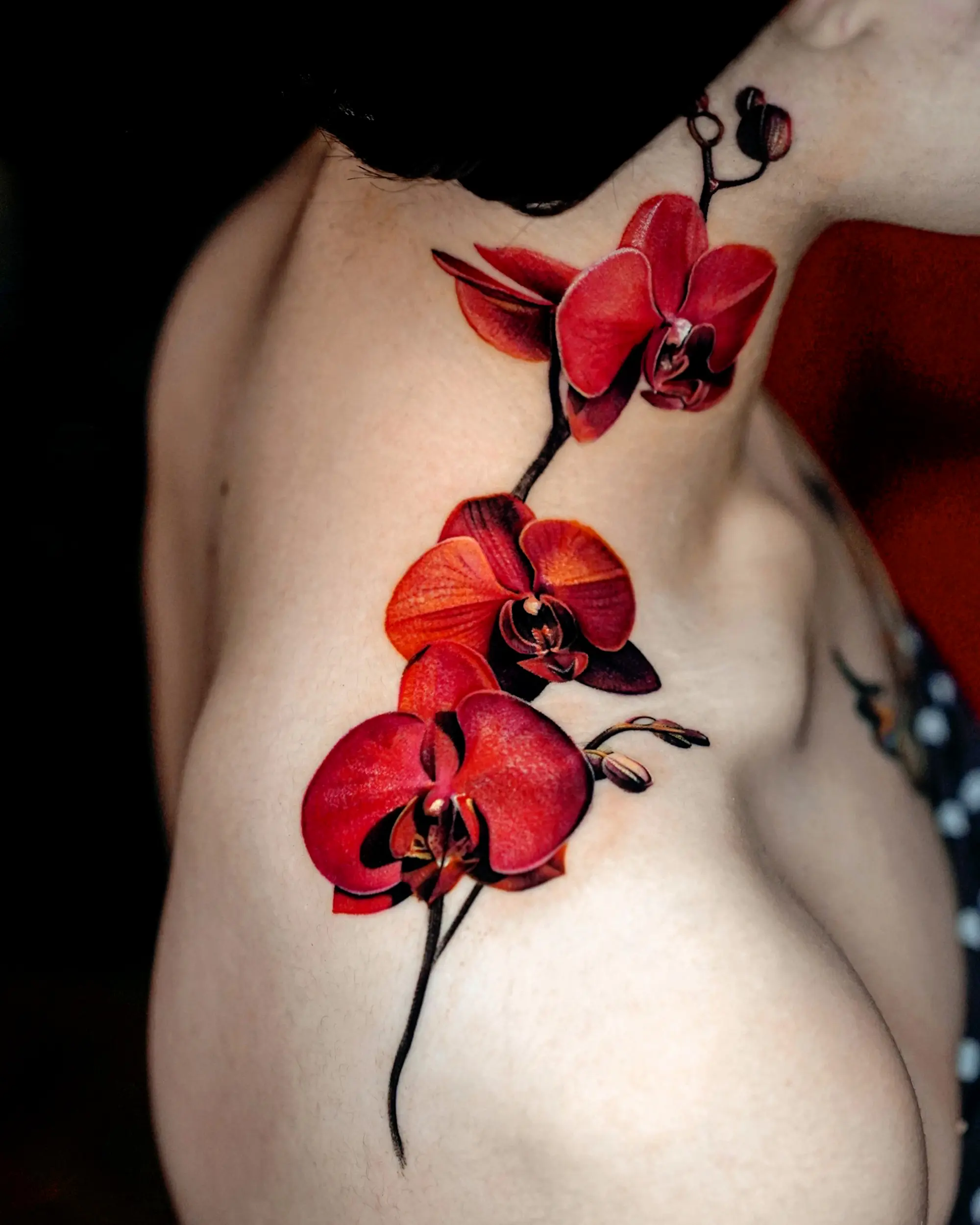
A crimson orchid, with its three-dimensional look, symbolizes strength, prosperity, and vitality.
While sharing a bit of yourself is part of using social media today, tattooer Myungdo (Hyung Do Lim) uses it only for professional purposes and keeps his personal life separate. The 29-year-old began his career in 2020, working in Singapore for a year before moving to Melbourne.
Myungdo’s work is immersed in deep, saturated colors: magentas, reds, oranges, greens, and blues. The focus is on florals. Sometimes these vivid flowers appear in dark rectangular frames. Other times, they drift freely across the body. Clients often ask for classics like roses, peonies, and orchids. His personal favorite remains the hellebore, a low-maintenance evergreen perennial.
For these detailed compositions, Myungdo uses 3 and 5 round liners (0803 bugpin and 1005 double-zero). He quietly observes the aging process, relying on repeat clients to track how his work progresses. Despite the durability of his color inks, the grey wash shading in older pieces faded faster than expected. As a result, he altered his black ink mixing and layering to improve results.
Outside the studio, he rides motorcycles. When traveling, he often visits botanical gardens to photograph plant references.
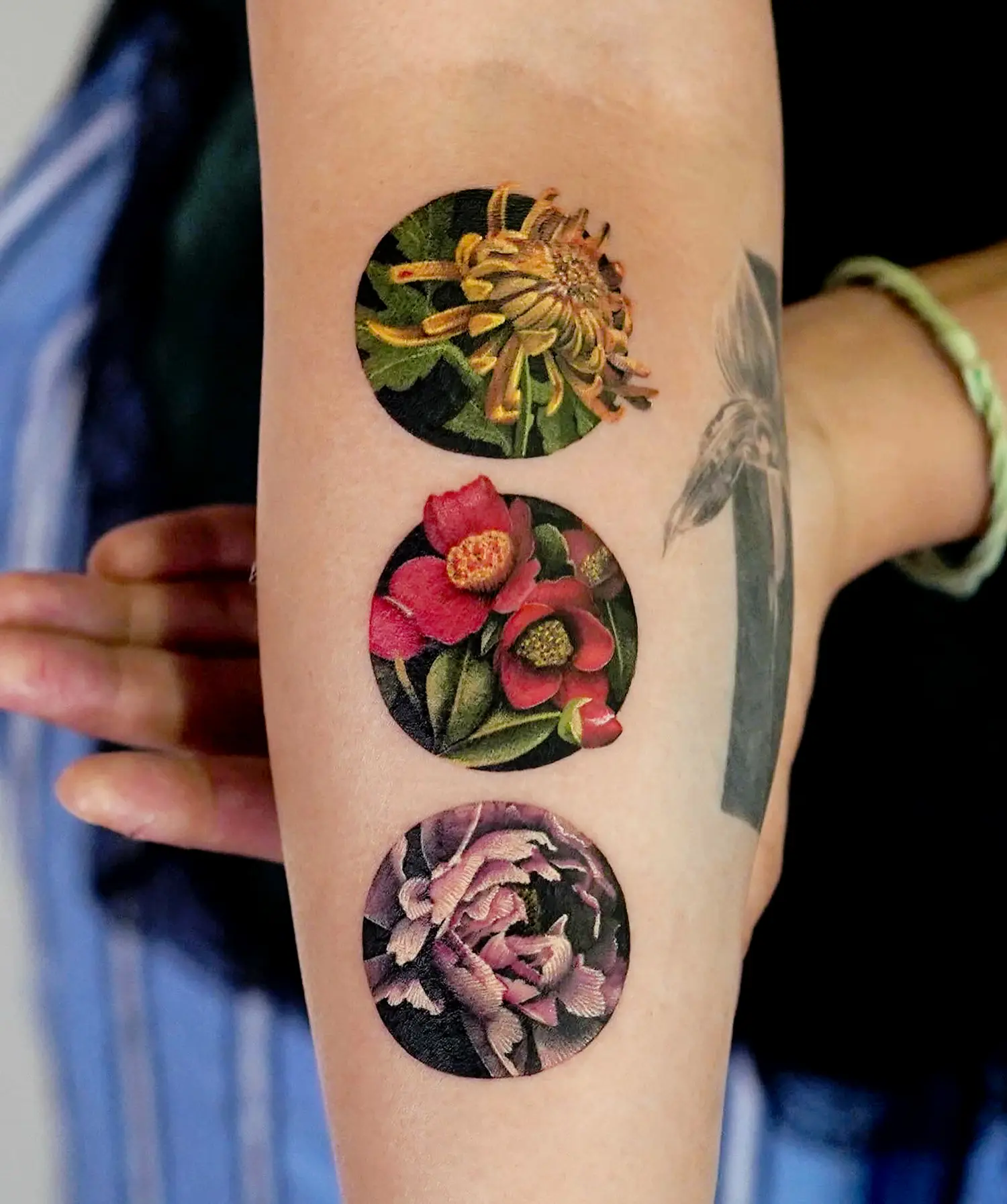
Different types of flowers, some inside a circle, others popping out.
What led you to focus on flowers? How do you source them—online, in books, in real life, or elsewhere?
I wanted to focus on a timeless subject to explore throughout my career. Flowers have always been classic and popular, with steady demand in the past and today.
I usually find floral references online. When I can photograph plants in person, especially in gardens, I use my photos as references.
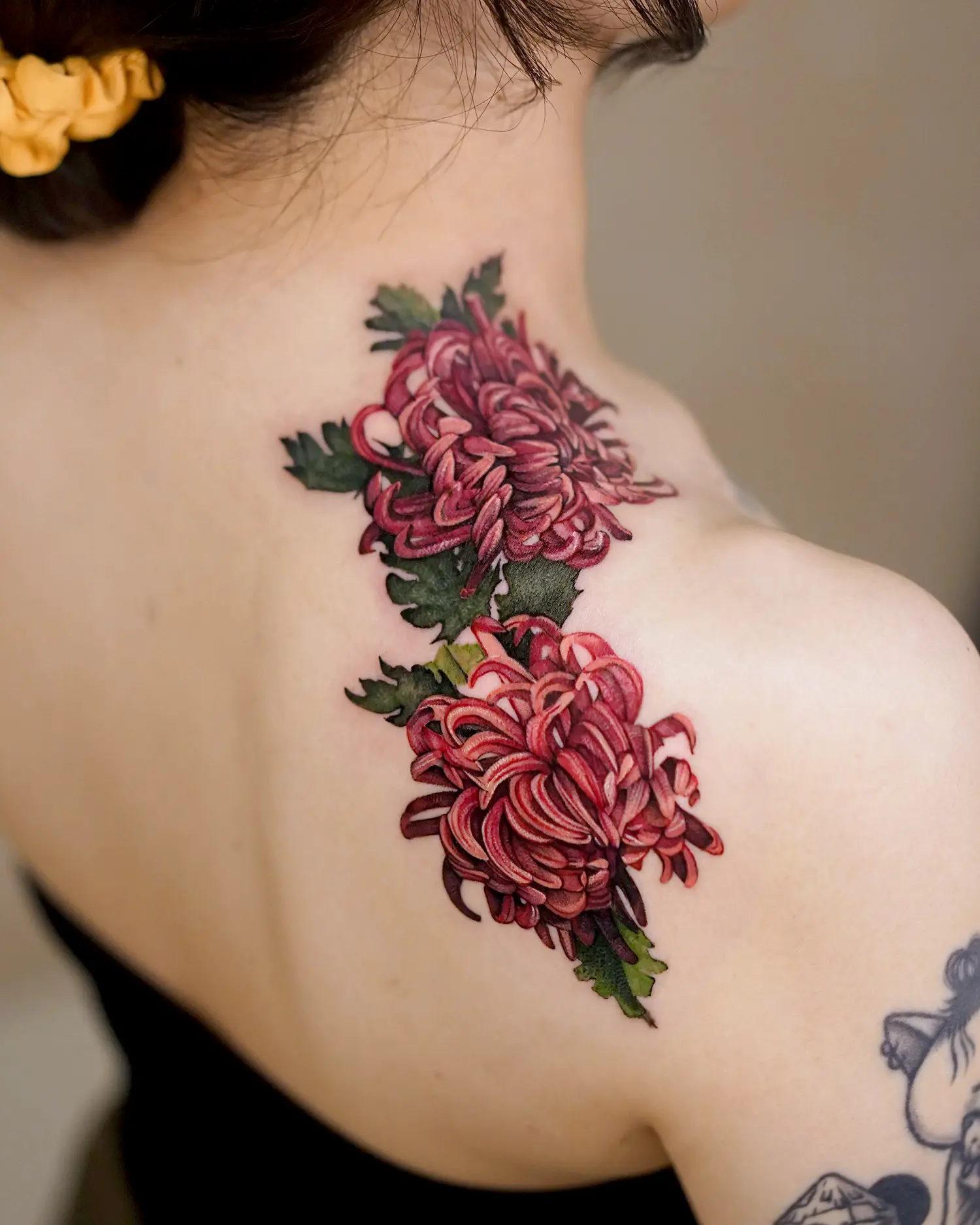
The chrysanthemum, with its exquisite detail, seems to jump off the skin and float in mid-air.
When aiming for 100% lifelike accuracy, do you ever feel trapped by reality, unable to be creative with a petal because the flower does not grow like that?
I don’t aim to represent every botanical characteristic with 100% accuracy. Tattooing is a form of illustration, so I may slightly alter shapes to suit the design. However, I try to preserve at least 80% of the plant’s defining characteristics. If I cannot find a reference showing the exact angle or appearance I want, I modify only the specific areas needing adjustment.
Although lifelike accuracy is important, my ultimate goal is to create designs that feel dreamy and classic. Rather than seeing accuracy as a restriction, I use it as a foundation for developing my own style.
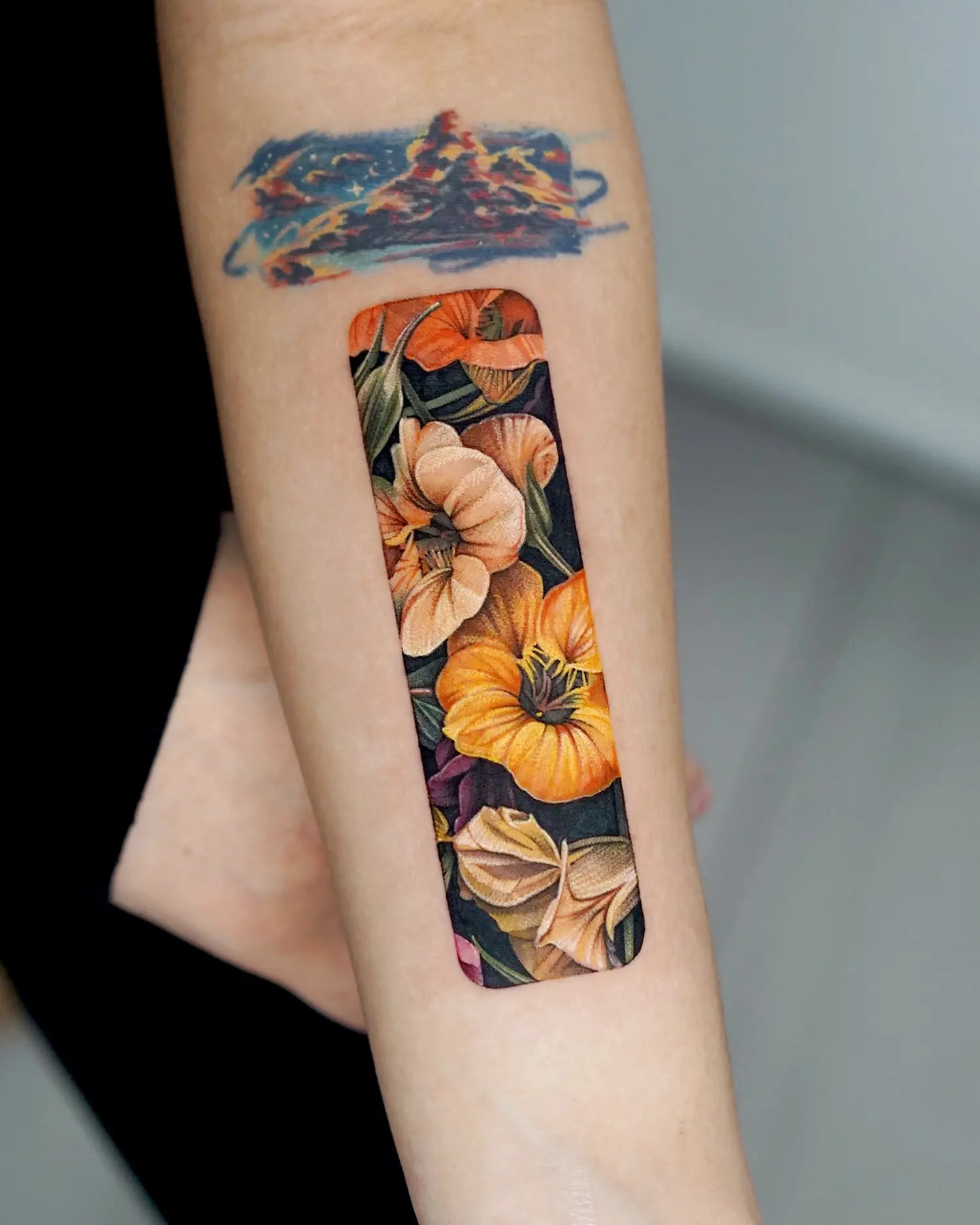
Sun-kissed and fully edible, nasturtiums represent strength and independence.
Does using a dark rectangular frame to make the plant pop make it easier to create 3D depth than a free-flowing piece on bare skin?
Yes. When the composition extends beyond the frame, the motif appears to project forward, creating a stronger sense of depth. Sometimes it even feels as though the plant is emerging from beneath the skin. One main reason I use a black background is that it maximizes the feeling of space. Black supports the other colors visually and strengthens the contrast between them. It also lets darker colors connect fluidly with the background, helping the entire palette feel cohesive.
Compared with a design without a frame or solid black background, I believe a black rectangle creates a much stronger three-dimensional effect. I also pay close attention to the viewer’s visual path within the rectangle and try to guide the eye naturally from the main focal point to the secondary elements.
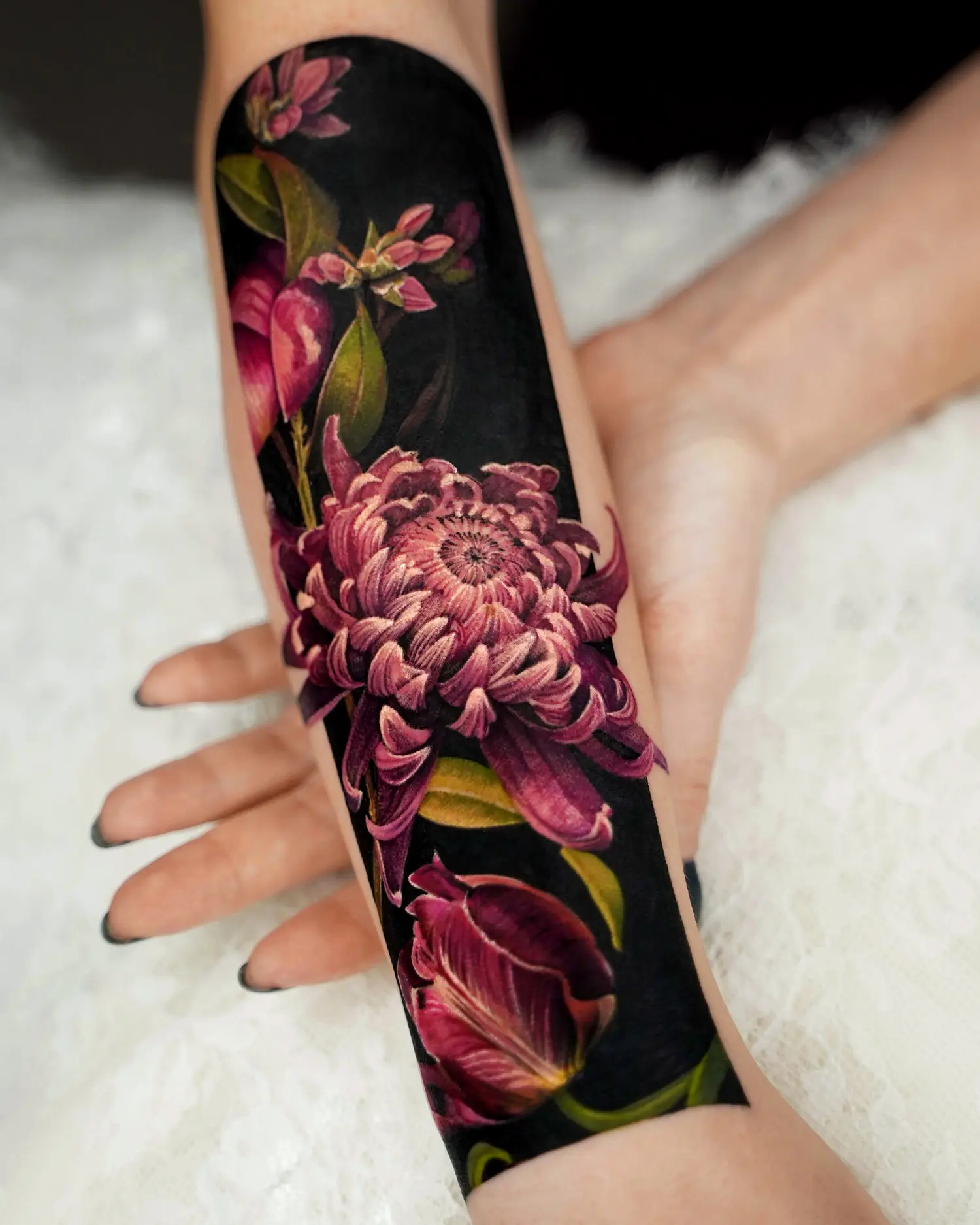
One of Myungdo’s most breathtaking pieces shows the chrysanthemum framed by a dark geometric border, popping in full blossom.
How many hours and sessions did this flower piece above take?
I created this project in Paris. It took approximately 18 hours over two sessions.
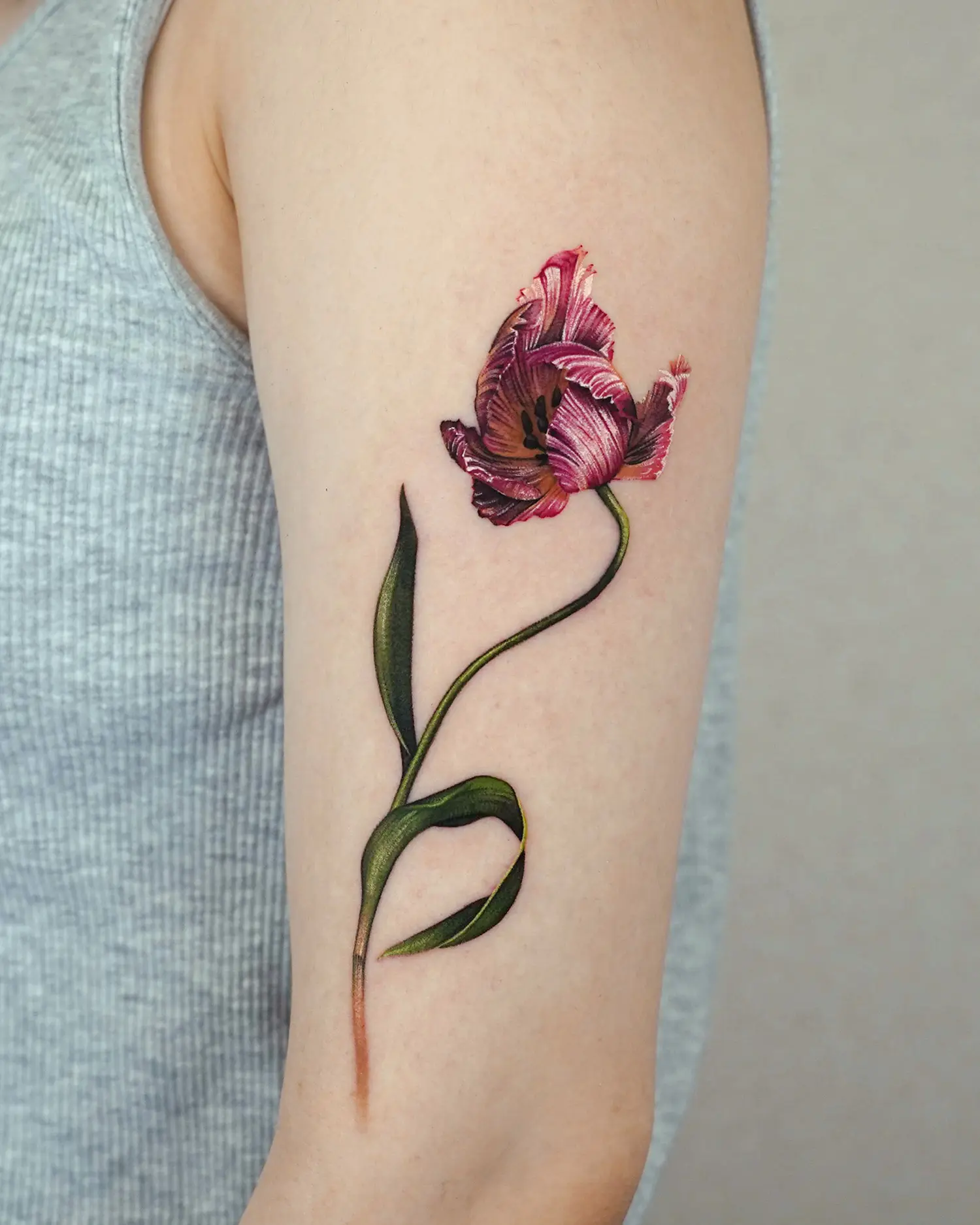
A single parrot tulip draws attention for its exotic, bird-like ruffled edges.
Do you ever want to break out and draw something totally surreal or morphed?
Yes, I feel that way at times. However, I don’t want to move in a completely different direction or change my artistic identity. Even when experimenting with surreal or altered elements, I want them to evolve organically within the style I have developed.
Right now, I mainly use simple geometric frames like rectangles and circles. In the future, I want to explore new frames influenced by East Asian aesthetics and larger, more complex compositions. Instead of changing my style entirely, I want to expand and strengthen my visual language by introducing new elements.
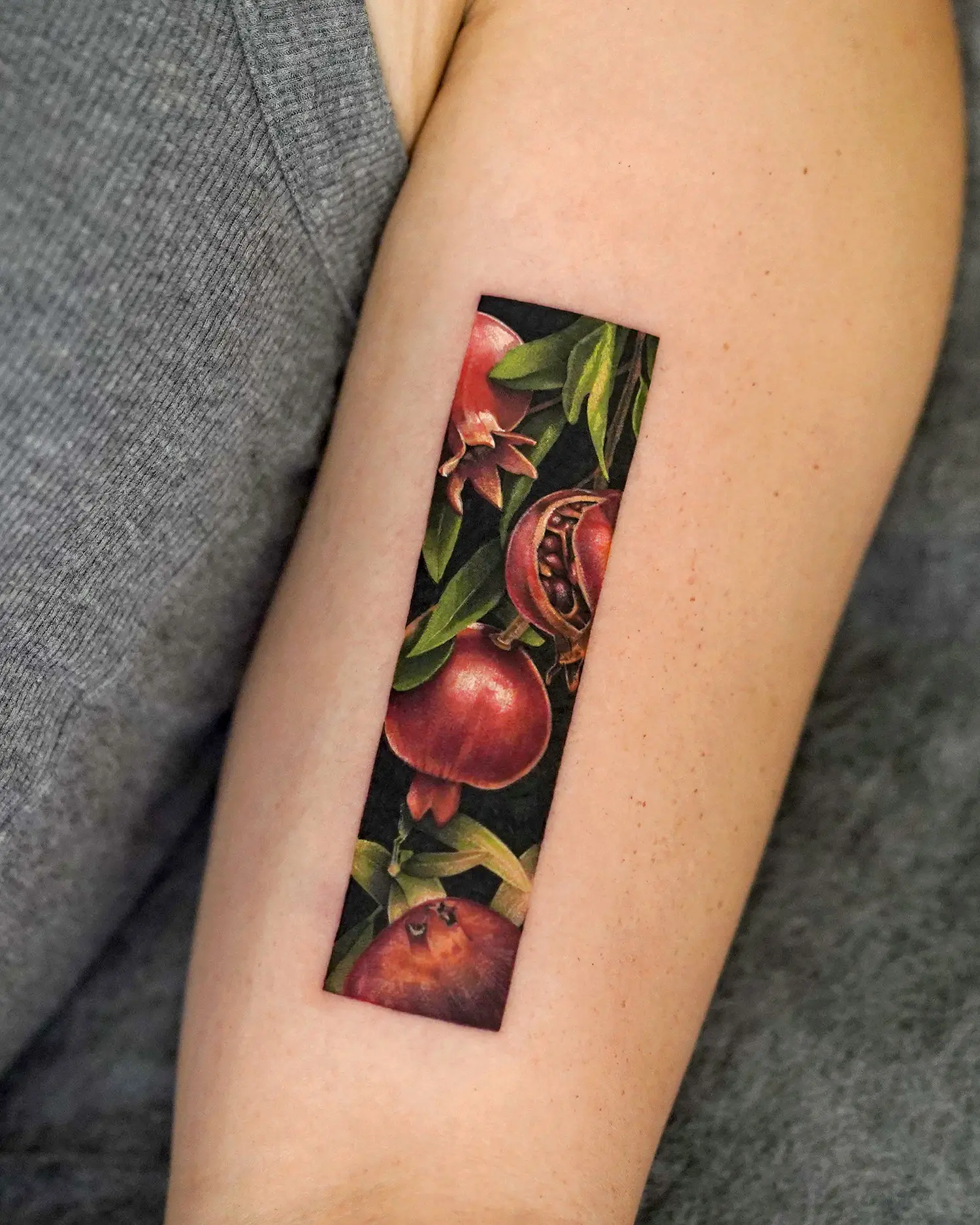
Beyond florals, the tattooer’s repertoire includes fruits, animals, and insects.
Do you use stencils for every tattoo?
I usually begin by applying a stencil of the entire design, including the botanical elements and the frame. The frames I use have many straight lines, but few areas of the body are flat or straight. After applying the stencil, I check whether the design flows naturally with the body’s contours. If any areas need adjustment, I refine the lines or shapes freehand rather than following the stencil exactly. This makes the design look more natural on the skin.
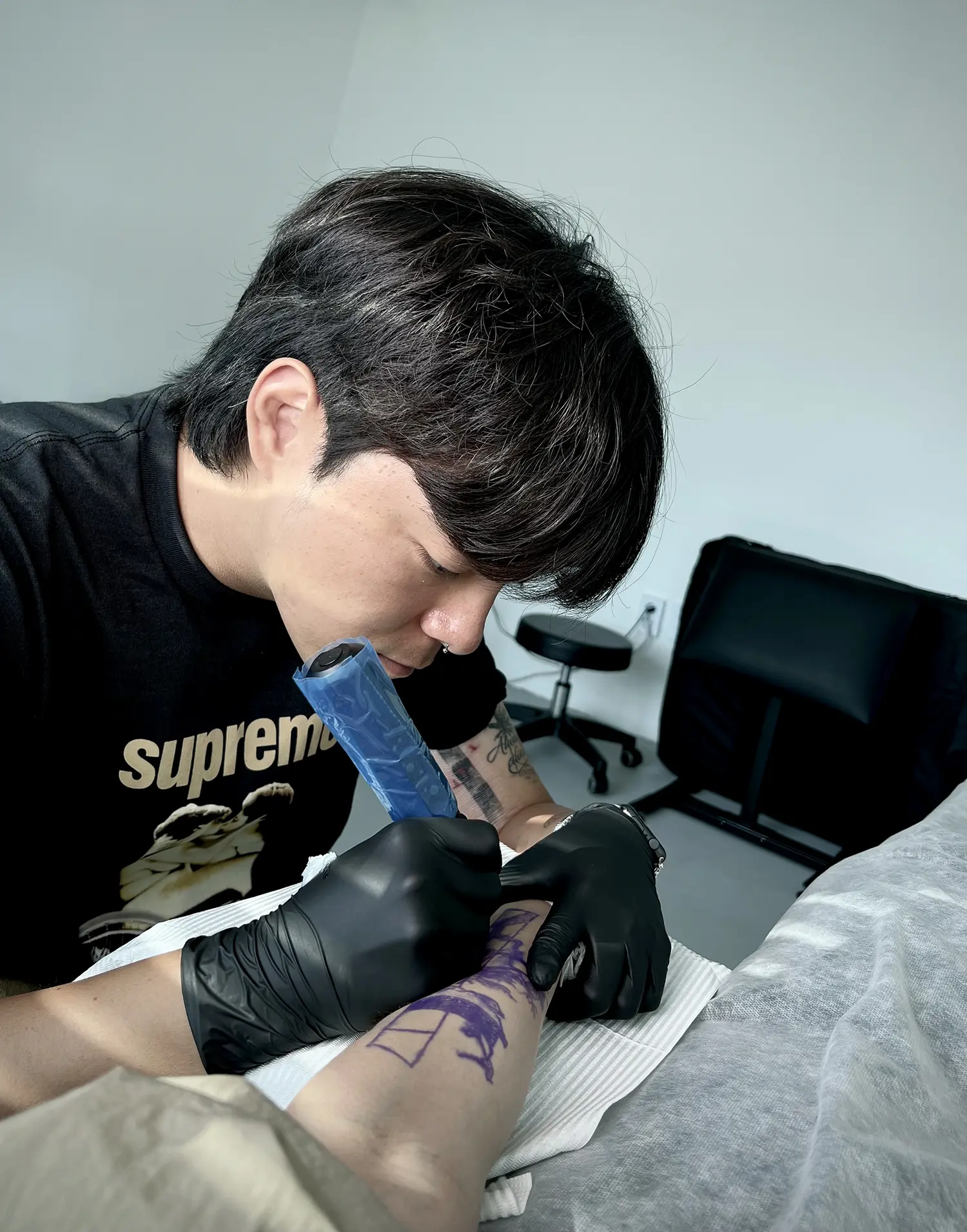
Gentle buzz of the machine, precision—Myungdo is in his flow state.
Fresh tattoos look vibrant, but as the body heals, those colors change over time. How do you set that expectation with clients?
When clients ask about healed tattoos, I explain that the vivid colors and contrast they see when the tattoo is fresh usually appear one shade softer after healing. I also let them know the final appearance can vary depending on their complexion and the tattoo’s placement.
I explain that white ink, in particular, can blend seamlessly into the skin as it heals. It may become very subtle or, in some cases, almost disappear.
I ask clients to take special care with their aftercare in the first week so the tattoo heals well.
I also reassure them that once it has healed completely, a touch-up is available if needed, so they don’t need to worry if the colors settle more softly than they initially appeared.
Photos © Myungdo